Search For Jobs, News, & Business Tips

Thursday, January 23, 2020

Finance Manager at Maersk

Lagos
APM Terminals is the global terminal operating arm of the A.P. Moller-Maersk Group. APM Terminals operates a Global Terminal Network of 76 operating port and terminal facilities and 117 Inland Services operations in 58 countries around the globe.
We offer
APM Terminals Apapa Ltd. offers tremendous growth, career and leadership opportunities for those with the ambition, drive and dedication to become one of the best. If you see yourself being part of a team that helps the global economy grow through our worldwide network of customers and terminals, then we definitely want to hear from you!

Working at APM Terminals brings a unique blend of being part of an exuberant, enthusiastic and fast-paced logistics company. You will have the opportunity to be exposed to various fields of expertise, from operations to customer service that will accelerate your development. We believe in encouraging our employees to learn, take risks, and grow their careers.
Key responsibilities
  • Ensure safe and sound status of liquid fund, improve net working capital management, maintain proactive dialogue and follow up with accounts receivable key stakeholders.

  • Thorough analysis and review dig deeper in the data reported and improve the quality of the reports including commentary for Managing Director and SMT members.

  • Fixed Asset Register and depreciation.

  • Spare Parts inventory account management.

  • Accounts Receivable: Credit Control: Receipting.

  • Accounts Payable: Supplier payment in accordance with company authorization/approvals.

  • To co-ordinate with GSC and ensure that off-shored tasks are carried out timely, accurately and completely.

  • To oversee the operations of the Payables function to ensure vendors are paid accurately and efficiently.

  • To oversee the performance of receivables function to ensure customer invoices are correctly and timely issued.

  • Ensure that local finance and controls are complete, accurate and timely in line with global guidelines and local laws and regulations.

  • Drive TCO (Take Cost Out) and Revenue Improvement initiatives as per Annual Operating Plan.

  • Revenue and Cost accruals as per APM GAAP and IAS.

  • Payroll: manage timely payment of payroll and adherence to payroll tax.

  • Verification of statutory deductions (PAYE/NHF/Pension).

We are looking for
  • Requires at least five years of progressively more responsible general accounting and finance experience preferably in the private sector, and in transportation or related industry.

  • Education - master’s degree in finance/ACCA/CA preferred.

  • Must be familiar with finance and banking concepts and the tools for analyzing financial decisions, based on modern financial theory, including such things as discounted cash flow techniques, capital budgeting and valuation; investment decisions, analysis of corporate financial policy, including capital structure, cost of capital, financial markets, and merger and acquisition activities.

  • Must be familiar with commercial law, credit agreements, concession and management agreements, and other related legislation, decrees, and legal opinions.

  • Extensive knowledge of setting of ROFO /budgets, reporting in HFM/ZIMPL, inventory control systems and accounting, knowledge of ERP systems, IFS financials software is an advantage.

  • Extensive knowledge of APM Terminals operational practices preferred.

  • Experience in the operation of APM Terminals container facilities preferred.

  • Analyses performance statistics and trends in order to identify areas for improvements and cost savings i.e. cost saving potentials.

  • Incumbent must have a very high level of analytical skills & must have complete IT skills as required in an office environment.

  • Must be able to evaluate solutions for both long and short-term benefit.

  • Exhibits sound judgment. Measures results and takes corrective action when needed.

  • Exhibit effective negotiation skills.
Apply Here>>> 

Audit Officer at Laterna Ventures Limited 2020

Audit Officer

Lagos
  • Similar Jobs

Audit Officer

Laterna Ventures Limited

Accounting, Auditing & Finance

Laterna Ventures Limited

Accounting, Auditing & Finance

Lagos|Full Time|Retail, Fashion & FMCG| 75,000 - 150,000

Job Summary

A Retail & Wholesales company requires the services of a qualified and experienced Internal Audit Officer to enforce compliance of procedures
  • Minimum Qualification: HND
  • Experience Level: Entry level
  • Experience Length: 3 years

Job Description

A Retail & Wholesales firm requires the services of a qualified and experienced candidate for this position.

Responsibilities:
  • Ensure compliance with company policies vis-a-vis cash, credit and inventory
  • Ensure adequate safeguard inventory items
  • Participation in stock taking and ensure proper conduct of exercise
  • Review of creditors and debtors accounts for due payments and overdue receipts
  • Establishment of good security network to safeguard the assets of the company
Qualifications and Requirements:
  • Candidates must be Accounting graduates.
  • A minimum of 2-years post qualification experience in the Internal Audit function
  • Hands-on knowledge of accounting software such as Navision would be an added advantage
Apply here>>> 

Ascentech Services Limited Recruitment for Digital Marketing Executive

Ascentech Services Limited is a full-fledged Human Resource Solution Provider incorporated in 2013 with its Head Office in Lagos, Nigeria. We are committed to forging long-term partnerships with our clients by creating and delivering robust and flexible services that address the changing needs of their business.
We are recruiting to fill the position below:
Job Position: Digital Marketing Executive
Job Location: Delta
Responsibilities
  • Plan and execute all digital marketing, including SEO/SEM, marketing database, email, social media and display advertising campaigns
  • Design, build and maintain our social media presence
  • Measure and report performance of all digital marketing campaigns, and assess against goals (ROI and KPIs)
  • Identify trends and insights, and optimize spend and performance based on the insights
  • Brainstorm new and creative growth strategies
  • Plan, execute, and measure experiments and conversion tests
  • Collaborate with internal teams to create landing pages and optimize user experience
  • Utilize strong analytical ability to evaluate end-to-end customer experience across multiple channels and customer touch points
  • Instrument conversion points and optimize user funnels
  • Collaborate with agencies and other vendor partners
  • Evaluate emerging technologies. Provide thought leadership and perspective for adoption where appropriate.
Requirements
  • Degree in Marketing or a related field
  • Proven working experience in digital marketing
  • Candidate must reside in Delta State(Warri)
  • Demonstrable experience leading and managing SEO/SEM, marketing database, email, social media and/or display advertising campaigns
  • Highly creative with experience in identifying target audiences and devising digital campaigns that engage, inform and motivate
  • Experience in optimizing landing pages and user funnels
  • Experience with A/B and multivariate experiments
  • Solid knowledge of website analytics tools (e.g., Google Analytics, NetInsight, Omniture, WebTrends)
  • Working knowledge of ad serving tools (e.g., DART, Atlas)
  • Experience in setting up and optimizing Google Adwords campaigns
  • Working knowledge of HTML, CSS, and JavaScript development and constraints
  • Strong analytical skills and data-driven thinking
  • Up-to-date with the latest trends and best practices in online marketing and measurement.
How to Apply
Interested and qualified candidates should send their CV to: cv@ascentech.com.ng with the "Job title" as the subject of the email

If Your Dog Is Eating Grass, Is It Time To Take Him To the Veterinarian?


Posted by: Dr. Natalie Waggener on
,

No one really knows why dogs eat grass, in part because there’s been very little scientific study of this behavior in dogs. In the absence of such analysis, many theories have been floated. Some scientists believe, for example, that eating grass is a dog’s attempt to compensate for something lacking in his diet—for example, a lack of sufficient fiber, vitamins or minerals.

Others argue that eating grass is a remnant of undomesticated dogs’ behavior, since many varieties of wild dogs have been observed eating grass. Dogs in the wild are omnivorous, eating both meat and plant materials, for example, and domesticated dogs are simply replicating the behavior of their ancestors, according to the proponents of this theory. Still others speculate that dogs just like the taste of grass, and some believe eating grass is a dog’s attempt to induce vomiting, perhaps to remove something that’s upsetting his stomach.


Have There Been Any Scientific Studies?

If you Google, “why do dogs eat grass,” you’ll find more than 2 million results, but if you try to find scholarly articles on the subject, you’ll come up empty, or almost empty. Stanley Cohen, Professor Emeritus in Psychology at the University of British Columbia and a prolific writer on the subject of dogs and dog psychology, attempted to find some scientific basis for the phenomenon of grass eating in dogs. He found only one relevant study:


“When I searched the scientific literature I was astonished to find that there was only one study dealing with the issue of grass eating and it was relatively recent (2008). The research was conducted at the University of California, Davis, by Karen Sueda, Benjamin Hart and Kelly Cliff and published in the journal Applied Animal Behavior Science.”

That study was designed to test the hypothesis that dogs eat grass to induce vomiting because of illness. The analysis was not especially robust, simply questioning 25 veterinary students about behaviors they had observed in their own dogs. All of the students said their dogs ate grass, none observed any sign of illness prior to their dogs eating grass, and only 8% reported seeing their dogs vomit after eating grass—hardly definitive. The researchers then expanded their sample group, first to 47 dog owners, and then online to more than 1,500 dog owners, concluding that there is no scientific basis for dogs eating grass because they are sick and want to induce vomiting.


Do Dogs Just Eat Grass Because They Like the Taste?

Andrea Rediger, writing for the Purdue University College of Veterinary Medicine, after dismissing the idea that eating grass is an attempt to compensate for vitamin or mineral deficiencies in their diet, or to induce vomiting, suggests that dogs might eat grass just because it tastes good:


“Maybe dogs just like to eat grass. Maybe it tastes good or has a pleasing texture. Perhaps it's a compulsive behavior or something we condition with unintentional reinforcement. Who can say for sure why dogs choose to eat what they do? What makes a rotting carcass and the new sofa such delectable treats?”


Is Eating Grass Dangerous for Dogs?

There is no evidence that eating grass could be dangerous for your dog. The Purdue article does point out, however, that owners who observe a sudden increase in this behavior might want to have their veterinarian check for an underlying gastrointestinal disease. Your vet can conduct a physical exam, including fecal and blood testing, to check for inflammation or blood loss into the GI tract, or some other underlying illness.

The bottom line is that, although no one knows with any degree of scientific certainty why dogs eat grass, observing your dog eating grass isn’t a cause for undue alarm. If, however, you are concerned that your dog's behavior might be a sign of some underlying illness, you might want to take him to your veterinarian to be checked out. If you have questions about this or other issues related to your dog's health and well-being, contact us today.

Why Does My Dog Eat Grass?


You feed your dog a nutritious food full of everything they need to grow and be healthy, so why do they insist on eating grass?
While no one is entirely sure why dogs eat grass, pet experts are fairly certain it's just normal canine behavior and probably nothing to worry about. There are two main types of canine grass eating: grazing and instinctive behavior.

Grazing

The first reason why dogs might eat grass is grazing, where your dog happily munches on grass and suffers no ill effects. Every dog has their own unique traits, but it's not uncommon to see this behavior when your pet is anxious, or maybe even a little bored.
Some vets suggest dogs eat grass to make up for a nutritional deficiency but even dogs that eat well-balanced diets will eat grass. It's possible that they simply like the taste. So even if you're feeding your dog well, they might still fancy some fiber or greens!

Instinctive behavior

The other type of grass eating is thought to be more of an instinctive behavior. This is thought to be a deliberate attempt to induce vomiting after they've swallowed something that makes them feel ill. It is possible your dog is suffering from an upset stomach, and their instinct is to throw up as a form of relief.
Dogs that eat to make themselves vomit usually swallow grass as quickly as possible, barely even chewing it. It is believed that the long, unchewed pieces of grass tickle their throats to stimulate vomiting.

Safe to eat?

With all grass-eating behavior, it’s important to keep a careful eye on the sort of grass your dog is eating. Don't let them eat anything that has been treated with pesticides or fertilizers. Double check your lawn care products to ensure whether or not they're safe for pets.

How can I get my dog to stop eating grass?

If your dog’s grass eating is starting to concern you, there are some things you can try to help curb the habit. As previously mentioned, your dog may have a nutritional deficiency that is causing their upset stomach, so making adjustments to their food or eating habits can make an impact on your pet's behavior over time. Make sure to ask your vet what would be a good food to feed to ensure you do not make their digestion problems worse. Please note that you should transition your pet's food gradually over time.

How do I know if my dog needs to go to the vet?

If your dog eats grass then vomits and seems fine, they’ve probably taken care of whatever was bothering them. If they keep eating grass and vomiting, you should take them to see the vet. If you’re ever concerned that this might not be a normal behavior, it is best to consult your vet immediately.
Typically, the occasional grass grazing isn't a cause for concern, but if your dog compulsively ingests foreign objects on a regular basis, you may want to see if they have pica. Pica is a medical condition in dogs that leads them to crave or eat items that are not typically thought of as food. Cloth, dirt, paper, garbage and feces are all things that dogs with pica may be drawn to, and if left unchecked can lead to nutritional and digestive issues.
Overall, grass eating shouldn’t be a major cause for concern, but there are things you can do to make it less of an issue for your pet (as well as the lawn). If you ever feel like the habit is becoming a concern, contact your vet for a professional recommendation.

How To Answer "Why Should I Hire You?" 2020

The HR interview question “Why Should I Hire You” turns out to be tricky no matter how simple it may sound. It may leave you feeling as if you are compared to other candidates but that’s how it is. I always feel that this question entails a list of my qualities that the interviewer wants me to speak out, and THAT makes the situation really awkward!

This article aims at sketching out a few customised answers to the question “Why Should I Hire You?”, which would give you a clear idea of how to create an edge for yourself in this one!

A general answer to “Why Should I Hire You”

Possible Answer 1:

“Over the years, I have acquired relevant skills and experience, which I shall bring to your organization. I have also worked tirelessly on my communication abilities and teamwork skills, which I will put to use in my future career, which would be in your organization if I am selected for the position. I have given my 100% effort in my past companies, and this has enabled me to recognize my capabilities and limitations. If I channelize them further, they will bring fruitful results to me and also to your esteemed organization.”

Possible Answer 2:

“This is a wonderful opportunity for me to get interviewed at such a renowned company. Your organization will surely prove to be an excellent platform for me to establish my skills and knowledge in the corporate world. Even though I am a fresher, I assure you that I will give my best and work to my full potential so that I can contribute as much as I can towards the growth and welfare of this great brand.”

Possible Answer 3:

“Honestly, I possess all the skills and experience that you’re looking for. I’m pretty confident that I am the best candidate for this job role. It’s not just my background in the past projects, but also my people skills, which will be applicable in this position. On the other hand, I am a self motivated person and I try to exceed my superior’s expectations with high-quality work. Being a fast learner, I quickly pick up business knowledge related to my project. Lastly, I would like to add that I work well both as an individual contributor and also as a team member. Collectively, all these skills put together makes me a complete package for this job.”

Possible Answer 4:

“I feel that I should be hired by you given my excellent academic background along with the skills and experience the company is looking for. I have the experience and the attitude to excel. If given a chance, I will surely work towards building my expertise, which would prove beneficial for me as well as your organization.”

Possible Answer 5:

“My manager recently told me that he’s never seen anyone with more advanced Microsoft Office skills than me! But, I would like to admit that I have acquired all my skills on job, from my past experiences, which when implemented at your organization, can bring much value and growth to this esteemed organization. I think the job role being offered will serve my purpose along with the development of the organization.”
Now read our profile-wise customised answers to the interview question “Why should I hire you” below.

Possible Answer 6:

A fresher’s answer to the question
“My academic records stand me apart from other job seekers. Having graduated from Hindu College, which is one of the premier colleges in the country, has exposed me to interaction and teamwork with students with high intellect and belonging to various cultures and backgrounds. Also, studying in this college gave me immense opportunities to delve in various extracurricular activities like Rotary Club, participation in Chess competitions and other activities such as dramatics, poetry and a few sports events too. Also, living in hostel premises made me a much stronger and an organized person with a wide network of friends and acquaintance. I believe that apart from a good academic background, these qualities go a long way in shaping personalities and creating efficient workforce.”

Possible Answer 7:

Sample answer for a software tester or test engineer or quality analyst
“Working as a Software Tester with reputed organisations like TCS and HCL Technologies has given me first hand experience of working in the field of testing. In my past career, I bagged several critical manual and automated software testing projects, which gave me a holistic view on the work front. I even got the opportunity to lead several projects for which I even got certificates. All in all, I have about 5 years of experience in the domain, which is an adequate time span for anyone to look forward to gaining an experience in people management in a reputed company. And for this, I look upto your organisation to give me a chance in my preferred domain.”

Possible Answer 8:

How possibly an academician cum trainer could answer this question
“My 4 years of involvement with the education industry has led to my intense understanding of the area. Being the Branch Manager of a play school, I got an opportunity to gain experience of the nitty-gritty of the business and emerge as a leader. I also got a platform to directly interact with the parents, children and the teachers, following which, I created a roadmap of the education trend we cumulatively envisaged to impart to our students, which I feel would be of huge benefit to your organization. I also looked after the financial management of the school which is an added benefit to my candidature. Playing the role of a mentor has made me capable of handling a situation with patience and perseverance, which also is an added virtue to my profile. My past experience and skills make me an ideal candidate for this position in your organization.”

Possible Answer 9:

An answer fit for a professional with around 5 years of experience
“I am a person with experience in varied types of writing. I have on my sleeves the expertise of writing for a news magazine, creating content for the web and editing of documents for the study abroad industry.I have been able to gain versatility in the sphere of writing and this definitely is a boon for my profile and a company like yours which values creativity. I have read your company’s blogs and they clearly resonate with my style of writing, which is very well apparent by the written test I have taken. Given my flair for creative writing and my intensive experience in the content industry, I feel that I am an apt candidate for this role.”

Possible Answer 10:

An HR person’s take on the question
“Being an HR personnel for the past 3 years has gained me expertise in delivering training, organizing learning modules, presenting concepts and instructional activities. It has also enabled me to maintain a close contact with professionals in other departments as well, which has led me to develop a birds-eye view of an organization taking my knowledge to the next level. From my personal understanding of your company, the HR department plays a major role in the system of things and my 3-year experience as an HR professional will certainly allow me to leverage my skills and experiences at your esteemed organization.”

Possible Answer 11:

How a person with a sales profile would possibly answer the question ‘Why Should I Hire You’
“As a Sales Supervisor of a 5-member team, I have managed to create a network of distributors and retailers, a network I will bring to your organization if hired. Also, I bring along a vast experience in the Sales industry, which would benefit the department as a whole. Thus, my qualification and background as a reliable resource to my past company make me a suitable candidate for the position of a Sales Manager at your reputed firm.”

Possible Answer 12:

This is how a counsellor can answer ‘Why Should I Hire You’
“My job as a study abroad counsellor has allowed me to work with various students belonging to varied backgrounds aspiring to seek admission in varied countries. This has allowed me to gain extensive knowledge about different countries and their academic experience and exposure they provide to the students. This, I feel is the main requirement of the job description and thus I also feel that I perfectly fit this role.”
So there you are! All these sample answers will be of much use when you face this tricky interview question “Why should I hire you”. Turn your answer into a confident 2-minute-long speech. The idea is to practice, rehearse and research. Do a thorough research on the company beforehand, read your job description well and rock it on the big day! All the best. ?

Interview Question: "Why Should We Hire You?"

Interviewing


Why should we hire you response overview

You have a passion for the work and proven abilities.
You have differentiated experience in this field.
You have exceptional drive and determination to succeed.
You have unique skills that separate you from other candidates.
You are able to elevate their teams current capabilities.
You have a deep belief in the company mission.
You feel a sense of connection to the company and team culture.

Employers ask many different questions during an interview. Because they only have a short window to assess whether or not you might be a good fit for the role, they want to understand a few key things at the end of your interview. Those things include whether you are a good culture fit for the company, if you can be successful in the role and how you might contribute to their short and long-term business goals.

One question you might be asked by employers is, “Why should we hire you?” While it might seem like a tough interview question, there are a few steps you can take to prepare a thoughtful, impressive response. To answer, “Why should we hire you?” you should:

Study the job posting
Research the company
Tie your background to the job posting
Quantify your accomplishments
Go above and beyond

How to answer “Why should we hire you?”

Employers might ask this question to learn a few different things about you. First, they want to know what differentiates you from other candidates they might be interviewing. In other words, what would they gain by hiring you specifically over other interviewees. They might also ask this question to see how you handle difficult situations because it can be challenging to explain why you’re the best person for a job in a humble, thoughtful way.

Take a few moments before your interview to plan an answer for this question. When preparing, you might consider the following steps to craft a response:


Study the job posting. To understand the specific skills, qualities and experience employers are looking for in an ideal candidate, review the job posting. Pay special attention to the job description and key sections like “Requirements,” “Experience” and “Education.” Find commonalities between what the employer is looking for and the skills, experiences and qualities you have to offer.


Research the company. Spending time studying the company’s mission, goals and recent announcements can help you to answer this question. You should use this information to explain how you are connected to their values and how you might help them accomplish key business goals.


Tie your background to the job posting. Explain how your experience, skills and attributes make you the best fit for the job as it pertains to the company and position for which you’re applying. You should address each of the requirements listed in the job posting, as well as any additional qualities that make you a great fit.


Quantify your accomplishments. When possible, support your accomplishments with numerical results. For example, if you’re applying for a job as an accountant at a company that is looking for someone to streamline processes, you might explain that at your previous company, you implemented a new process for expense accounts that reduced time-to-reimbursement by 25%.


Go above and beyond. Think of any relevant qualities or experiences that set you apart from other candidates. For example, if you held a previous professional or volunteer position that gives you a unique perspective beneficial to the job you’re applying for, that might be something that distinguishes you.

Related: Top 16 Interview Questions and Answers

Example “Why should we hire you?” answers

As you are planning your answer to this interview question, use the below examples as inspiration.

Example 1: Office administrator
“You should hire me for my passion and proven abilities in organization for office efficiency. In my previous role as an administrative assistant, I came up with a plan to reorganize the office supply closet by category. We placed fewer orders and saved 30% on office supplies year over year. I’m excited to bring my skills to this role.”

Example 2: Kitchen manager
“My experience accurately managing inventory intake and skills in creating effective, streamlined schedules make me uniquely qualified to succeed in this kitchen manager position. I understand that you require a highly organized candidate with acute attention to detail. In my previous job, I successfully handled schedules for 20 employees and reduced food waste by 15%. I’m excited about the prospect of bringing my organizational skills to your restaurant.Example 3: Social worker
“You should hire me for this position because of my proven ability to maintain strong interpersonal relationships with several clients. I am passionate about providing care to those in need in my community, which keeps me motivated and excited about doing my best work. I understand you need a candidate who can be consistently available for events in clients’ lives. I have a 100% attendance rate for weekly case proceedings and meetings for my clients. In addition, I can bring leadership experience to your team, having trained over 20 new hires to become fa

The complicated truth about a cat’s purr


Similar Articles

The truth about dog years

The curious intelligence of crows

Why do we think cats are unfriendly?

Why do sloths move so slowly?

Our cats may purr when we pet and tickle them, but it’s a much more complicated form of communication than we've assumed.


By Stephen Dowling 25th July 2018

We think we know what a cat’s purr means.

It is arguably the most recognisable sign of animal contentment: a pleasurable rasp that erupts whenever a cat is tickled or petted, the soundtrack to countless sessions sprawled on an owner’s lap.

But that’s not quite the full story. There is a lot more going on with the cat’s purr than you might reasonably expect.

Even the ‘how’ was long a subject of debate. Some thought it was linked to blood flowing to the inferior vena cava, a vein that carries deoxygenated blood to the right side of the heart. But with more research it seemed likelier that the noise came from the muscles within the cat’s larynx. As they move, they dilate and constrict the glottis – the part of the larynx that surrounds the vocal chords – and the air vibrates every time the cat breathes in or out. The result? A purr.


Even though science is now fairly sure this is the process, there’s no definitive answer as to what triggers the response. The biggest clue is a neural oscillator deep within the cat’s brain, one that otherwise has no clear purpose.

But if that neural oscillator is triggered, is it just when a cat is happy?

Sometimes. But only sometimes.


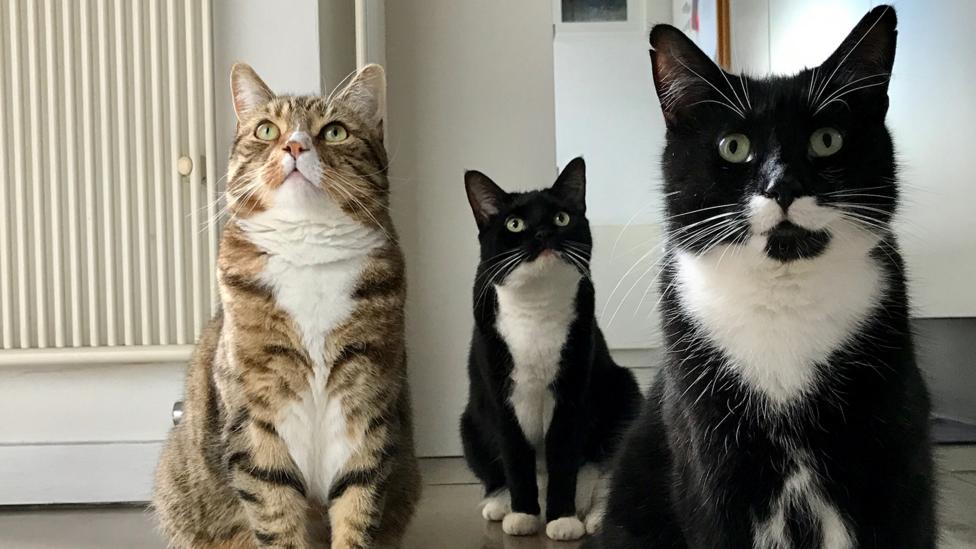
Marjan Debevere says in her experience no two cats purr the same (Credit; Marjan Debevere)


Marjan Debevere is a cat shelter photographer in London who is currently studying for a degree in feline psychology. She is also the owner of four cats – Clive, Hula, Luigi and Archie – who are something of an Instagram sensation (33,000-odd followers and counting, Instagram fans).


People assume they’re happy when they’re purring. That’s just not always the case – Marjan Debevere


Part of the mystery around the purr is that we often only notice cats purring “when we tickle them in places that they like to be tickled”, says Debevere. Yet they also purr when we’re not around, and the extent of that purring varies between individuals. “All cats are different, some never purr and some will purr constantly,” she says. She draws the comparison between her cat Luigi – a stray who followed someone in to their office and was subsequently taken to a shelter – and Archie, who “moved in from next door” and became part of the family. Luigi purrs little, and Archie a lot.

“I’ve photographed more than 3,000 cats so far [at shelters] and no two are the same,” Debevere says. “I’ve witnessed a lot of cats purring when they’re dying, and when they’re being put to sleep. The vet will say something like ‘They were purring right up until the end’, and people assume they’re happy when they’re purring. That’s just not always the case.”

The study of cats’ behaviour and communication has lagged behind that of dogs, which are usually more willing participants, especially if there is a reward of food involved. But in recent years more light has been shed on the purr.


We’re just beginning to understand it and there are more unanswered questions than answered – Gary Weitzman


"We’re just beginning to understand it and there are more unanswered questions than answered," says Gary Weitzman, a veterinarian and CEO of the San Diego Humane Society. "While the purr does generally represent contentment for cats, it can also express nervousness, fear and stress. Fortunately, more often it’s an indicator of the former.

"It’s been speculated for decades that purring was a form of communication. In the early 2000s we hypothesised that purring has other purposes besides this. Work by Elizabeth von Muggenthaler, Karen Overall, and others has led to a better understanding of the purpose of the purr. It’s likely that purring has communication, appeasement, and healing properties," Weitzman says.


Cats will often purr on their own - it's believed it promotes bones and tissue growth (Credit: Alamy)


Cats begin purring when they are a few days old, which helps their mothers locate them for feeding time. This may persist with some adult cats who purr as they feed – or who purr beforehand as they try and convince a human it’s dinner time. Some will purr loudly when they are cautiously investigating new environments (my own cat purrs loudest when it’s exploring the back of the wardrobe). Cats may also purr after they’ve been startled, or after stressful episodes like being chased by a dog.

The more science has delved into the purr, the more it seems to have uncovered. "Researchers have recorded 'ordinary purrs' and purrs that were soliciting food from their owners," says Celia Haddon, an author and cat behavioural expert.
"Even non-cat owners could tell the difference. Inside the ordinary low purr was a higher frequency cry, somewhat like a meow.

"This particular sound is rather like the isolation cry of kittens or the human baby distress cry. We humans are naturally sensitive to the baby cry, so we respond also to the cry within the purr."

Sam Watson, the scientific officer at the UK’s animal charity the RSPCA, says there is still little understanding of how cats purr amongst each other in the wild, though it’s apparent that they will purr as they groom each other. “There could be one for ‘I want that’, another for ‘Let’s share resources’. There are lots of things like that we know so little about.

“Feline communication is absolutely overlooked, and it deserves a lot more attention and study than it’s given today.”


It’s thought that the vibrations from the activity are physically rejuvenating – a way for the cat to ‘heal’ itself after stress


One hypothesis is that the purr is a powerful healing action. It’s thought that the vibrations from the activity are physically rejuvenating – a way for the cat to ‘heal’ itself after stress. The frequency of those vibrations – which range from 20Hz up to 150Hz – is thought to promote bone growth, as bones harden in response to the pressure. Other frequencies may do something similar to tissue.

“Purrs at a frequency of 25-100Hz correspond with established healing frequencies in therapeutic medicine for humans," Weitzman says. "Bone responds to 25-50Hz and skin and soft tissues to around 100Hz according to researchers."


Cats often purr when they're grooming each other (Credit: Marjan Debevere)


This is why we see cats purring in apparent contentment while dozing. In reality, it's a form of self-repair. Cats may have adapted their normal behaviour – which now involves spending a lot of the day resting – as a way of avoiding injury through over-exertion. The purr has developed as a low-energy way to keep bones and tissues in good condition while they rest.

And the purr may not just be of benefit to the cats themselves. Petting a cat has long been seen as a form of stress relief – cat ownership could cut the risk of stroke or heart disease by as much one-third. Those same frequencies cats purr at might also be doing good to us as well.


We respond to a cat’s purr as a calming stimulus – Weitzman


"I think the purr has a big benefit for humans," says Weitzman. "The physiological benefits aside, we’ve always responded to purring’s psychological effects. It calms us and pleases us, like watching waves against a beach. We respond to a cat’s purr as a calming stimulus and may have even genetically selected cats with more propensity to purr.”

Haddon agrees. “If it is winding round your feet, looking up at you, glancing towards the food cupboard or the fridge, you cannot miss the signs together with the loud purring that say it wants its food – now!


The purr from a happy cat may also be of benefit to human health (Credit: Alamy)

“In the morning loud purring can be used, together with human face patting or rubbing, to wake up a human and thus get breakfast. Most of us feed the cat before ourselves, which shows how effective their communication is.”

Ultimately, the quest to define the meaning of a purr may benefit from getting to know cats’ body language better – from the periscope tail of a friendly cat in sociable mood to the wide eyes and bent-back whiskers of a cat in fight mode. With this deeper knowledge, the bond between cat and owner can only grow.

--

Why is the sky blue?


Original by Philip Gibbs May 1997.


Why is the sky blue?

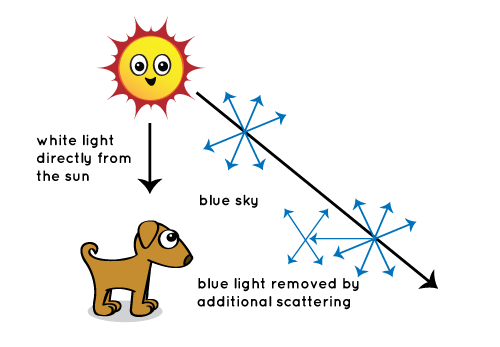
A clear cloudless day-time sky is blue because molecules in the air scatter blue light from the sun more than they scatter red light. When we look towards the sun at sunset, we see red and orange colours because the blue light has been scattered out and away from the line of sight.


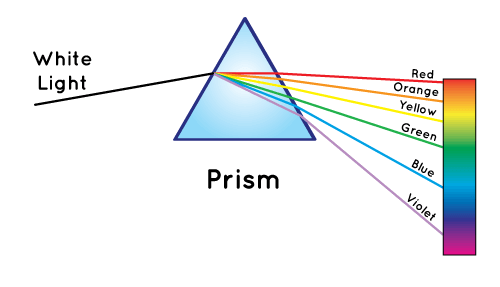
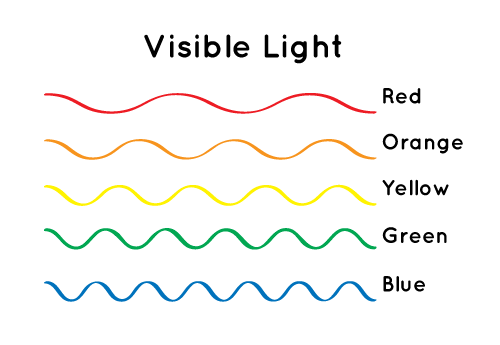
The white light from the sun is a mixture of all colours of the rainbow. This was demonstrated by Isaac Newton, who used a prism to separate the different colours and so form a spectrum. The colours of light are distinguished by their different wavelengths. The visible part of the spectrum ranges from red light with a wavelength of about 720 nm, to violet with a wavelength of about 380 nm, with orange, yellow, green, blue and indigo between. The three different types of colour receptors in the retina of the human eye respond most strongly to red, green and blue wavelengths, giving us our colour vision.
Tyndall Effect

The first steps towards correctly explaining the colour of the sky were taken by John Tyndall in 1859. He discovered that when light passes through a clear fluid holding small particles in suspension, the shorter blue wavelengths are scattered more strongly than the red. This can be demonstrated by shining a beam of white light through a tank of water with a little milk or soap mixed in. From the side, the beam can be seen by the blue light it scatters; but the light seen directly from the end is reddened after it has passed through the tank. The scattered light can also be shown to be polarised using a filter of polarised light, just as the sky appears a deeper blue through polaroid sun glasses.

This is most correctly called the Tyndall effect, but it is more commonly known to physicists as Rayleigh scattering—after Lord Rayleigh, who studied it in more detail a few years later. He showed that the amount of light scattered is inversely proportional to the fourth power of wavelength for sufficiently small particles. It follows that blue light is scattered more than red light by a factor of (700/400)4 ~= 10.
Dust or Molecules?

Tyndall and Rayleigh thought that the blue colour of the sky must be due to small particles of dust and droplets of water vapour in the atmosphere. Even today, people sometimes incorrectly say that this is the case. Later scientists realised that if this were true, there would be more variation of sky colour with humidity or haze conditions than was actually observed, so they supposed correctly that the molecules of oxygen and nitrogen in the air are sufficient to account for the scattering. The case was finally settled by Einstein in 1911, who calculated the detailed formula for the scattering of light from molecules; and this was found to be in agreement with experiment. He was even able to use the calculation as a further verification of Avogadro's number when compared with observation. The molecules are able to scatter light because the electromagnetic field of the light waves induces electric dipole moments in the molecules.
Why not violet?

If shorter wavelengths are scattered most strongly, then there is a puzzle as to why the sky does not appear violet, the colour with the shortest visible wavelength. The spectrum of light emission from the sun is not constant at all wavelengths, and additionally is absorbed by the high atmosphere, so there is less violet in the light. Our eyes are also less sensitive to violet. That's part of the answer; yet a rainbow shows that there remains a significant amount of visible light coloured indigo and violet beyond the blue. The rest of the answer to this puzzle lies in the way our vision works. We have three types of colour receptors, or cones, in our retina. They are called red, blue and green because they respond most strongly to light at those wavelengths. As they are stimulated in different proportions, our visual system constructs the colours we see.


Response curves for the three types of cone in the human eye

When we look up at the sky, the red cones respond to the small amount of scattered red light, but also less strongly to orange and yellow wavelengths. The green cones respond to yellow and the more strongly scattered green and green-blue wavelengths. The blue cones are stimulated by colours near blue wavelengths, which are very strongly scattered. If there were no indigo and violet in the spectrum, the sky would appear blue with a slight green tinge. But the most strongly scattered indigo and violet wavelengths stimulate the red cones slightly as well as the blue, which is why these colours appear blue with an added red tinge. The net effect is that the red and green cones are stimulated about equally by the light from the sky, while the blue is stimulated more strongly. This combination accounts for the pale sky blue colour. It may not be a coincidence that our vision is adjusted to see the sky as a pure hue. We have evolved to fit in with our environment; and the ability to separate natural colours most clearly is probably a survival advantage.


A multicoloured sunset over the Firth of Forth in Scotland.
Sunsets

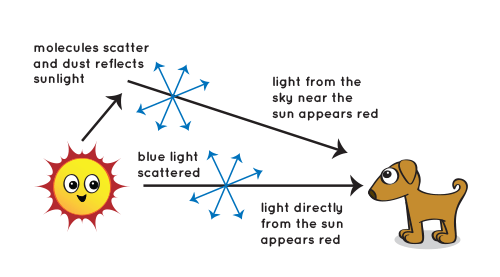
When the air is clear the sunset will appear yellow, because the light from the sun has passed a long distance through air and some of the blue light has been scattered away. If the air is polluted with small particles, natural or otherwise, the sunset will be more red. Sunsets over the sea may also be orange, due to salt particles in the air, which are effective Tyndall scatterers. The sky around the sun is seen reddened, as well as the light coming directly from the sun. This is because all light is scattered relatively well through small angles—but blue light is then more likely to be scattered twice or more over the greater distances, leaving the yellow, red and orange colours.


A blue haze over the mountains of Les Vosges in France.
Blue Haze and Blue Moon

Clouds and dust haze appear white because they consist of particles larger than the wavelengths of light, which scatter all wavelengths equally (Mie scattering). But sometimes there might be other particles in the air that are much smaller. Some mountainous regions are famous for their blue haze. Aerosols of terpenes from the vegetation react with ozone in the atmosphere to form small particles about 200 nm across, and these particles scatter the blue light. A forest fire or volcanic eruption may occasionally fill the atmosphere with fine particles of 500–800 nm across, being the right size to scatter red light. This gives the opposite to the usual Tyndall effect, and may cause the moon to have a blue tinge since the red light has been scattered out. This is a very rare phenomenon, occurring literally once in a blue moon.
Opalescence

The Tyndall effect is responsible for some other blue coloration's in nature: such as blue eyes, the opalescence of some gem stones, and the colour in the blue jay's wing. The colours can vary according to the size of the scattering particles. When a fluid is near its critical temperature and pressure, tiny density fluctuations are responsible for a blue coloration known as critical opalescence. People have also copied these natural effects by making ornamental glasses impregnated with particles, to give the glass a blue sheen. But not all blue colouring in nature is caused by scattering. Light under the sea is blue because water absorbs longer wavelength of light through distances over about 20 metres. When viewed from the beach, the sea is also blue because it reflects the sky, of course. Some birds and butterflies get their blue colorations by diffraction effects.
Why is the Mars sky red?

Images sent back from the Viking Mars landers in 1977 and from Pathfinder in 1997 showed a red sky seen from the Martian surface. This was due to red iron-rich dusts thrown up in the dust storms occurring from time to time on Mars. The colour of the Mars sky will change according to weather conditions. It should be blue when there have been no recent storms, but it will be darker than the earth's daytime sky because of Mars' thinner atmosphere.

Why Is the Sky Blue?


Why Is the Sky Blue?


The Short Answer:
Sunlight reaches Earth's atmosphere and is scattered in all directions by all the gases and particles in the air. Blue light is scattered more than the other colors because it travels as shorter, smaller waves. This is why we see a blue sky most of the time.

It's easy to see that the sky is blue.
Have you ever wondered why?

A lot of other smart people have, too. And it took a long time to figure it out!


The light from the sun looks white. But it is really made up of all the colors of the rainbow.

When white light shines through a prism, the light is separated into all its colors. A prism is a specially shaped crystal.

If you visited The Land of the Magic Windows, you learned that the light you see is just one tiny bit of all the kinds of light energy beaming around the universe--and around you!

Like energy passing through the ocean, light energy travels in waves, too. Some light travels in short, "choppy" waves. Other light travels in long, lazy waves. Blue light waves are shorter than red light waves.

All light travels in a straight line unless something gets in the way and does one of these things:—


reflect it (like a mirror)


bend it (like a prism)


or scatter it (like molecules of the gases in the atmosphere)


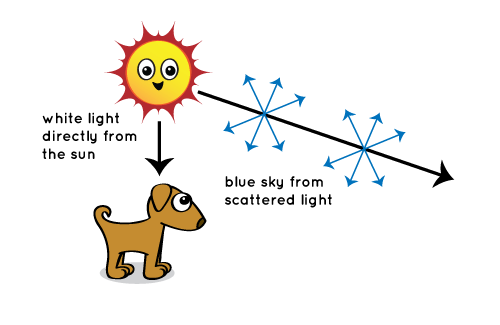
Sunlight reaches Earth's atmosphere and is scattered in all directions by all the gases and particles in the air. Blue light is scattered in all directions by the tiny molecules of air in Earth's atmosphere. Blue is scattered more than other colors because it travels as shorter, smaller waves. This is why we see a blue sky most of the time.

Closer to the horizon, the sky fades to a lighter blue or white. The sunlight reaching us from low in the sky has passed through even more air than the sunlight reaching us from overhead. As the sunlight has passed through all this air, the air molecules have scattered and rescattered the blue light many times in many directions.

Also, the surface of Earth has reflected and scattered the light. All this scattering mixes the colors together again so we see more white and less blue.


What makes a red sunset?

As the sun gets lower in the sky, its light is passing through more of the atmosphere to reach you. Even more of the blue light is scattered, allowing the reds and yellows to pass straight through to your eyes.


Sometimes the whole western sky seems to glow. The sky appears red because small particles of dust, pollution, or other aerosols also scatter blue light, leaving more purely red and yellow light to go through the atmosphere.

Is the sky blue on other planets, too?

It all depends on what’s in the atmosphere! For example, Mars has a very thin atmosphere made mostly of carbon dioxide and filled with fine dust particles. These fine particles scatter light differently than the gases and particles in Earth’s atmosphere.

Photos from NASA’s rovers and landers on Mars have shown us that at sunset there is actually the opposite of what you’d experience on Earth. During the daytime, the Martian sky takes on an orange or reddish color. But as the Sun sets, the sky around the Sun begins to take on a blue-gray tone.

The top image shows the orange-colored Martian sky during the daytime and the bottom image shows the blue-tinted sky at sunset. Both images were captured by NASA’s Mars Pathfinder Lander. Credit: NASA/JPL

Related Resources for Educators

Our World: Sunsets and Atmospheres

Why Does A Leap Year Have 366 Days?


Ashish


There is a leap day every 4 years because Earth completes one revolution around the sun in around 365 days and 6 hours. Over a period of 4 years, the extra 6 hours from every year get added up to become an entire day (6*4=24 hours). Hence, we have a leap day/leap year every 4 years.

The month of February is a wee bit different from other months in the sense that every 4 years, out of nowhere, a 29th day is added to it, and the month of February becomes one day longer than usual!
What is Leap Year?

A leap year consists of 366 days as opposed to a ‘regular’ year that consists of 365 days. Every 4 years, a year comes along that has one more day to it, meaning 366 days in total. Those years with 366 days are leap years. More specifically, the year in which the month of February has 29 days (instead of the usual 28 days) is deemed a leap year. For example, the year 2016 was a leap year.
How often is leap year?

A leap year comes every 4 years. A normal year has 365 days, but every 4 years, a leap year comes which has 366 days, i.e. 1 day more than a normal year.
When is the next leap year?

The next leap year is 2020. The last leap year was 2016, and since leap years come after 4 years, so the next leap year will come in 2020. (2016+4)
When is the next leap day?

The next leap year will be February 29, 2020. Leap days come after 4 years. Since the last leap day was 29 Feb 2016, the next leap day will be in the year 2020.
Leap year rules

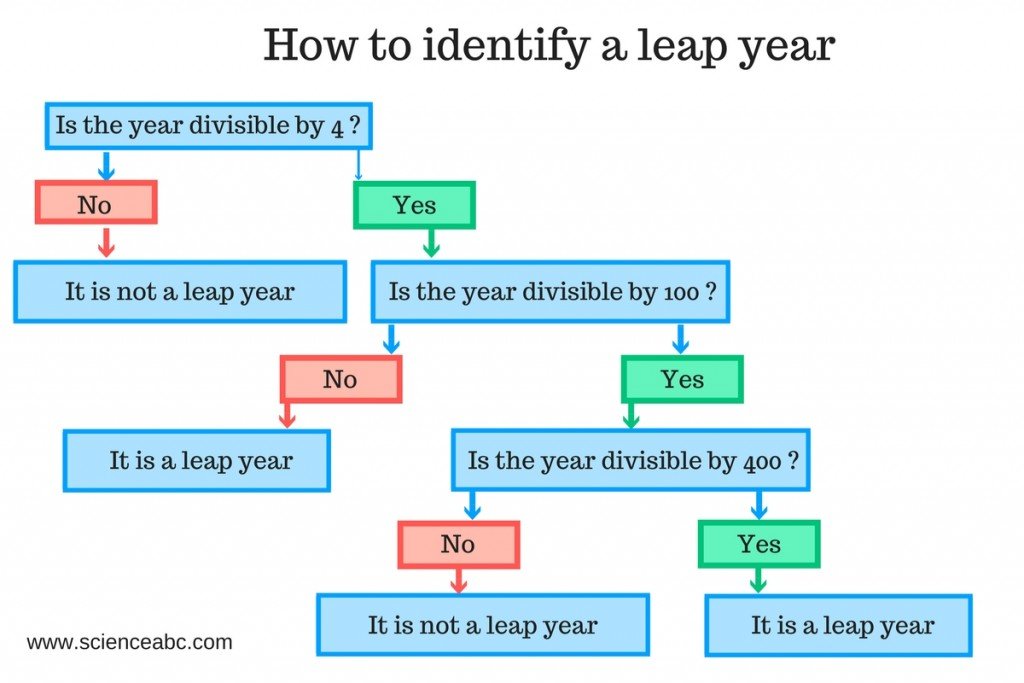
For a year to be qualified as a leap year, it has to satisfy these two conditions:

The year has to be perfectly divisible by 4. (e.g 2012, 2020 etc.)
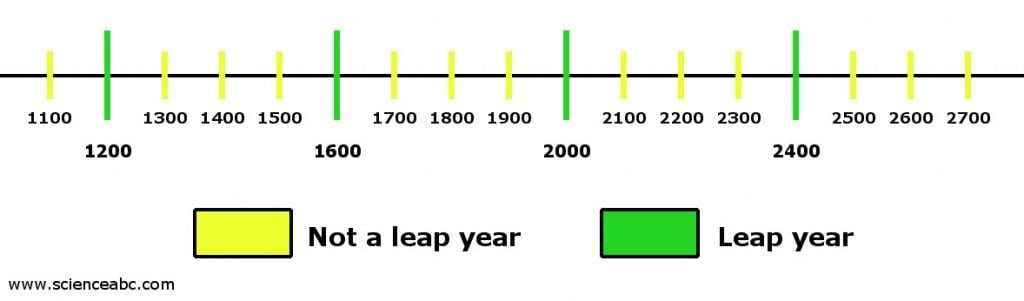
If the year is perfectly divisible by 100, then it’s not a leap year. However, if the same year is also perfectly divisible by 400, then it is a leap year (e.g. 1800 was not a leap year, since it was divisible by 100, but not by 400; but the years 1600, 2000 were).


Why Does Leap Year Have 366 days?

Leap years have 366 days because adding a day to the year is a necessity to maintain the smooth functioning of the Gregorian calendar that we all follow around the world. This calendar assumes that Earth takes 365 days and a quarter of a day to complete one revolution around the sun. So, every 4 years, that quarter of a day becomes an entire day and gets added to the year.

The calendar that the vast majority of the world follows is the Gregorian calendar. Also referred to as the Western calendar or Christian calendar, it’s named after Pope Gregory XIII and happens to be the most used civil calendar across the globe. This calendar is in perfect alignment with the Earth’s revolutions around the sun, which is a good thing (as the time taken by Earth to complete one revolution is almost exactly 365 days, which is the duration of a ‘year’).


Pope Gregory XIII

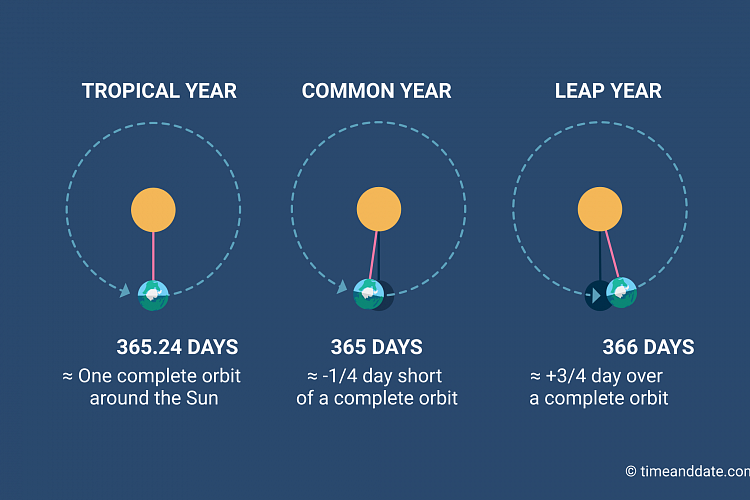
Although the Gregorian calendar assumes that Earth takes revolves around the sun in 365 days, but, it actually takes a little less than 365 days and 6 hours to complete one revolution around the sun. This time duration represents a tropical year (also known as a solar year, an astronomical year, or an equinoctial year) and its value almost always differs from a regular year.
Why a century is not a leap year?

Century years are not leap years because by adding 1 day to the year every 4 years, we end up adding too much over a period of 100 years. And that’s why every 100 years, we have to remove a day from the year.

You see, we generally assume that Earth completes one revolution around the sun in 365 days and 6 hours for simplification purposes. But, in reality, it does so in precisely 365 days, 5 hours, 48 minutes, and 45 seconds (365.242189 days). So, when we add a day to the year every 4 years, we end up over-correcting by a small margin.

In other words, it means that when we add 1 day to the month of February every 4 years, over a given period of time, we end up adding too much! In order to remove that excess addition, we remove 1 day from the year every 100 years. That’s the reason century years like 1700, 1800, 1900, 2100 etc. are NOT leap years.


However, using this mode of correction of the length of a year, when we take out 1 day from a century year, we over-correct in the opposite direction. In simple words, it means that we end up taking out a little too much from a year’s duration. This teeny-tiny amount of time, when accumulated over 400 years, becomes as long as a day. That’s the reason century years that are divisible by 400 are leap years (e.g. 2400, 1600 etc.).
Was 2000 a leap year?

Yes, 2000 was a leap year because 2000 is perfectly divisible by both 4 and 400. The years that are perfectly divisible by both 4 and 400 are leap years.


Since the duration of 1 year in the Gregorian calendar is 365 days only, it becomes necessary to add that extra day to February. If not, then we would miss 6 hours from our calendar every year. 6 hours may not seem to be that significant when one is talking in terms of years, but those 6 hours would continue to accrue and at the end of a century we would be off by roughly 24 days from our calendar!


Therefore, every four years, one day is added to the already shortest month of the calendar, i.e., February, which is precisely the reason why this year’s February page on the calendar had a 29th box.
What are the odds of being born on a leap day?

The probability of being born on the leap day is around 0.00068. In other words, your chances of being born on February 29 are 1 in 1461.To conclude, adding a day to February every 4 years is a practical requirement, not some majestic joke from an ancient Greek ruler who thought February was far too romantic to only have 28 days!
References
University of Illinois and Chicago
University of San Francisco
The short URL of the present article is: http://sciabc.us/Q8jiP

Why Is 2020 a Leap Year?

Learn How Leap Years Keep Our Calendar Accurate


By Catherine Boeckmann


2020 is a leap year! Find out why and what this means, and see when the next leap year will be. Plus, we’ll explain why leap years are necessary and share the fun folklore surrounding them.

What Is a Leap Year?

Simply put, a leap year is a year with an extra day—February 29—which is added nearly every four years to the calendar year.

Why Are Leap Years Necessary?

Adding an extra day every four years keeps our calendar aligned correctly with the astronomical seasons, since a year according to the Gregorian calendar (365 days) and a year according to Earth’s orbit around the Sun (approximately 365.25 days) are not the exact same length of time. Without this extra day, our calendar and the seasons would gradually get out of sync. (Keep reading for a longer explanation.)

Because of this extra day, a leap year has 366 days instead of 365. Additionally, a leap year does not end and begin on the same day of the week, as a non–leap year does.
How Do You Know If It’s a Leap Year?

Generally, a leap year happens every four years, which, thankfully, is a fairly simple pattern to remember. However, there is a little more to it than that.

Here are the rules of leap years:
A year may be a leap year if it is evenly divisible by 4.
Years that are divisible by 100 (century years such as 1900 or 2000) cannot be leap years unless they are also divisible by 400. (For this reason, the years 1700, 1800, and 1900 were not leap years, but the years 1600 and 2000 were.)

If a year satisfies both the rules above, then it is a leap year.

Why Is 2020 a Leap Year?

2020 happens to follow the rules of leap years:
2020 divided by 4 equals 505 with no remainder.
2020 is not a century year, so it does not need to be divisible by 100 or 400.

Therefore, 2020 abides by the rules of leap years and will have an extra day added to it: Saturday, February 29.
When Is the Next Leap Year?

A leap year occurs every four years.
Year Leap Day
2020 Saturday, February 29
2024 Thursday, February 29
2028 Tuesday, February 29
2032 Sunday, February 29

Why Do We Need Leap Years?

The short explanation for why we need leap years is that our calendar needs to stay aligned with the astronomical seasons.

One orbit of Earth around the Sun takes approximately 365.25 days—a little more than our Gregorian calendar’s nice, round number of 365. Because the calendar does not account for the extra quarter of a day that the Earth requires to complete its orbit around the Sun, it doesn’t completely align with the solar year.


Because of this .25 difference, our calendar gradually gets out of sync with the seasons. Adding an extra day, aka a “leap day,” to the calendar every 4 years brings the calendar in line and therefore realigns it with the seasons.

Without leap days, the calendar would be off by 5 hours, 48 minutes, and 45 seconds more each year.

After 100 years, the seasons would be off by 25 days! Eventually, the months we call February and March would feel like summer months in the Northern Hemisphere.

The extra leap day adjusts this drift, but it’s not a perfect match: Adding a leap day every four years overcompensates by a few extra seconds each leap year, adding up to about three extra days every 10,000 years.
What Is a Leap Day? And a Leapling?

A “leap day” is the extra day in the leap year: February 29.

A “leapling” is a person born on a leap day. Any leap day babies out there? We’d love to hear from you in the comments below!
Leap Year Facts and Folklore
Ages ago, Leap Day was known as “Ladies Day” or “Ladies’ Privilege,” as it was the one day when women were free to propose to men. Today, Sadie Hawkins Day sometimes applies to Feb 29 (leap day), based on this older tradition.
According to folklore, in a leap year, the weather always changes on Friday.
“Leap year was ne’er a good sheep year” (old proverb)

Are Leap Years Bad Luck?

Many feel that to be born on Leap Day, thereby becoming a “leapling,” is a sign of good luck.

In some cultures, it is considered bad luck to get married during a leap year.

We don’t know of any evidence supporting that marriage theory, but we do know that during leap years:
Rome burned (64),
and the Titanic sank (1912).

By the same token, also in leap years:
the Pilgrims landed at Plymouth, Massachusetts (1620),
Benjamin Franklin proved that lightning is electricity (1752),
and gold was discovered in California (1848).

Do you have any leap year memories? Are you a Leapling yourself? Please share in the comments below!


Source:
The Old Farmer's Almanac

Leap Day: February 29, 2020


By Vigdis Hocken

A Leap Day, February 29, is added to the calendar during leap years. This extra day, also called Leap Year Day, makes the year 366 days long – not 365 days, like a common year.


Role reversal on leap day.

©iStockphoto.com/AntonioGuillem
When Is the Next Leap Day?

The next leap day is Saturday, February 29, 2020.

The last Leap Day was on Monday, February 29, 2016.
Why Add a Leap Day?

Leap days are needed to keep our calendar in alignment with the Earth's revolutions around the Sun.

It takes the Earth approximately 365.242189 days – or 365 days, 5 hours, 48 minutes, and 45 seconds – to circle once around the Sun. This is called a tropical year.

Without an extra, or intercalary, day on February 29 nearly every four years, we would lose almost six hours every year. After only 100 years, a calendar without leap years would be off by approximately 24 days in relation to fixed seasonal days such as the vernal equinox or the winter solstice.

Is There a Perfect Calendar?
Caesar Introduced Leap Years

Roman general Julius Caesar implemented the first leap day in his Julian Calendar, which he introduced in 45 BCE. A leap day was added every four years. At the time, leap day was February 24, and February was the last month of the year.
Too Many Leap Years

However, adding a leap day every four years was too often and eventually, in 1582, Pope Gregory XIII introduced the Gregorian Calendar. This calendar, which we still use today, has a more precise formula for calculation of leap years, also known as bissextile years.


Leap day as a concept has existed for more than 2000 years and it is still associated with age-old customs, folklore, and superstition. One of the most well-known traditions is that women propose to their boyfriends, instead of the other way around.

What's a Leap Second?
Leap Months

The ancient Roman Calendar added an extra month every few years to maintain the correct seasonal changes, similar to the Chinese leap month.

What Is a Leap Year?


What Is a Leap Year?

By Vigdis Hocken

A leap year has 366 days instead of the usual 365 days, and occurs nearly every four years. The extra day during leap years is leap day on February 29.


Leap years have 366 days, not 365.
Is 2020 a Leap Year?

Yes, the next leap day is February 29, 2020.

The previous leap day was February 29, 2016.
Why Do We Have Leap Years?

We need leap years to keep our modern-day Gregorian calendar in alignment with Earth's revolutions around the Sun.

It takes Earth approximately 365.242189 days, or 365 days, 5 hours, 48 minutes, and 45 seconds, to circle once around the Sun. This is called a tropical year, and astronomers measure this from the March equinox.

However, the Gregorian calendar has only 365 days in a year. If we didn't add a leap day on February 29 nearly every four years, we would lose almost six hours off our calendar every single year. After only 100 years, our calendar would be off by around 24 days!

Is There a Perfect Calendar?
Leap Year Rules

We add a leap day on February 29, almost every four years. The leap day is an extra, or intercalary, day and we add it to the shortest month of the year, February.
How to Calculate Leap Years

In the Gregorian calendar, three criteria must be taken into account to identify leap years:
The year can be evenly divided by 4;
If the year can be evenly divided by 100, it is NOT a leap year, unless;
The year is also evenly divisible by 400. Then it is a leap year.

According to these rules, the years 2000 and 2400 are leap years, while 1800, 1900, 2100, 2200, 2300 and 2500 are NOT leap years.
Special Leap Year 2000

The year 2000 was somewhat unique as it was the first instance when the third criterion was used in most parts of the world since the start of the transition from the Julian calendar to the Gregorian in 1582.


Julius Caesar introduced leap years.©bigstockphoto.com
Who Invented Leap Years?

Roman general Julius Caesar introduced the first leap years over 2000 years ago. But the Julian calendar had only one rule: any year evenly divisible by four would be a leap year.

This formula produced way too many leap years. Still, it was not corrected until the introduction of the Gregorian calendar more than 1500 years later.
Leap Months

The ancient Roman Calendar added an extra month every few years to maintain the correct seasonal changes, similar to the Chinese leap month.

What Is a Leap Second?

2020 MSc Scholarships At University of Queensland in Australia

Applications are invited from outstanding and enthusiastic individuals who have an interest, and preferably a background, in Biomedical Imaging Technology and are willing to pursue a degree program at University of Queensland, Australia. They should have basic understanding of object orientated coding principles and basis knowledge and experience in a programming language: C++, Matlab, Python or equivalent.
Eligible Countries: International
Type: MPhil
Value of Award: $34,013
Number of Awards: Not Known
Eligible Field of Study: The studentships are awarded in the subject area of engineering and computing, health and behavioural sciences, science and mathematics.
Eligibility: 
  • Applicants must be International students
  • Applicants must have to submit the cover letter, CV, academic transcript/s and evidence for meeting UQ’s English language proficiency requirements eg TOEFL, IELTS.
  • A bachelor’s degree with honours class IIB or better from approved universities, which includes relevant experience
Application Process: To be considered for this scholarship, please email the following documents to CIBIT Manager (administrator@cibit.org.au)
  • Cover letter
  • CV
  • Academic transcript/s
  • Evidence for meeting UQ’s English language proficiency requirements eg TOEFL, IELTS
Submitting the above documents does not constitute a full application for admission into The University of Queensland’s PhD program. If you are selected as the preferred applicant, you will then be invited to submit a full application for admission. You can familiarise yourself with the documents required for this process on the Graduate School’s website.
Visit The Scholarship Webpage For More Information
Application Deadline: February 2, 2020

Snowdon MSc Program for International Students in UK, 2020

The Global Disability Innovation Hub is currently looking for brilliant aspirants from all around the world with the ability to become leaders of the future to apply for Snowdon masters programmes.
There are up to 8 scholarships available for high calibre students who want to start a master’s course in autumn 2020. Successful candidates will join a unique network of high achieving disabled leaders working together to inspire future generations.
Course Level: Masters
Award: £30,000
Access Mode: Online
Number of Awards: 8
Nationality: Any
The award can be taken in the UK
Eligibility            
  • Eligible Countries: Open to the UK and International individuals with impairments
  • Acceptable Course or Subjects: Masters programme will be awarded in any subject offered by the university
  • Admissible Criteria: To be eligible, the applicants must meet all the following criteria:
  • Seeking exceptional leaders, with the ability to create change and influence
  • Applicants should have shown excellence within their chosen field of study
  • Candidates should be able to demonstrate genuine leadership potential and have a proven drive for success
  • Influencers and role models, who have shown their ability to create change are encouraged to apply
  • Success candidates will have achieved proven success through academic, employment or voluntary activities, and have experience of collaboration or mentoring
  • It’s important to explain the impact of your impairment and what difference receiving the program would make to you.
How to Apply: In order to apply for the grant, candidates need to take part in the master’s program. Thereafter, applicants should apply through the online application form.
  • Supporting Documents: To apply, candidates must be ready to submit the previous transcripts at the university.
  • Admission Requirements: For taking admission, applicants must have an undergraduate degree from a recognized university.
  • Language Requirement: Students need to demonstrate that they have a good level of written and spoken English.

 Benefits

The successful candidates will receive all the following benefits.
– A stipend of £15,000 p.a. whilst studying
– The opportunity to join a unique network of high achieving disabled leaders working together to inspire a new generation
– Up to £15,000 p.a. funding towards fees for a UK Masters course. The maximum funding available per student is £30,000.

Apply Now

Application Deadline: April 5, 2020

ICD International Scholarship at University of Twente in the Netherlands

For removing financial barriers for high-calibre overseas candidates, the University of Twente is offering the ICD University of Twente International Scholarship in the Netherlands.
The awards are available for excellent applicants from both EU/EEA as well as non-EU/EEA countries applying for a Master of Science in Electrical Engineering at the University of Twente.
Course Level: Postgraduate
Award: € 6,000 for one year
Number of Awards: two
Access Mode: Online
Nationality: International
The award can be taken in the Netherlands
Eligibility
  • Eligible Countries: Applicants from EU/EEA countries as well as non-EU/EEA countries are eligible to apply for the award.
  • Eligible Course or Subjects: Masters degree in Electrical engineering
  • Eligibility Criteria: Students are required to take admission to the master’s degree program at the university.
How to ApplyTo apply, aspirants have to enrol in the postgraduate degree coursework at the University of Twente.
  • Supporting Documents: Students have to attach the following documents:
  • An official transcript of records or preliminary transcript of records in Dutch or English
  • A valid international passport
  • Curriculum vitae (CV)
  • Letter of motivation
  • Contact information of two references
  • Admission Requirements: For taking admission, candidates must fulfil the entry requirements of the university.
  • Language Requirement: If your native language is not English, aspirants have to provide evidence of the English language proficiency.
Benefits: Each successful scholar will receive the amount of € 6,000 for one year.

Apply Now

Application Deadline: Varies

2020 King Carl Gustaf Scholarships At Uppsala University, Sweden

The Uppsala University, Sweden is offering the King Carl Gustaf Funding program to international students who are seeking to undergo a degree program at the Institution. The King Carl Gustaf Scholarship is aimed at students who live in unsafe and dangerous conditions in areas of conflict outside Europe. Scholarships will cover the cost of tuition, but not living expenses, for studies at Uppsala University Master’s programmes offered during the current admission round and commencing 31 August 2020.
Eligible Countries: Applications are open from Afghanistan, Cameroon, DR Congo, Egypt, India, Iraq, Libya, Mali, Mexico, Nigeria, Somalia, South Sudan, Syria, Turkey, Yemen.
Type: Masters
Value of Awards: Cost of tuition
Number of Awards: Not known
Eligibility:
  • Applicants must have applied for the Master’s programme at the university.
  • Applicants must hold a bachelors degree from an internationally recognised university.
  • Applicants must be fluent in English Language
  • Applicants must be citizens of from Afghanistan, Cameroon, DR Congo, Egypt, India, Iraq, Libya, Mali, Mexico, Nigeria, Somalia, South Sudan, Syria, Turkey, Yemen
  • Applicants must show why they are particularly vulnerable and therefore in need to belonging to the education environment at University as well as having the academic talent required.
Application Process: Applicants are advised to take admission in the postgraduate degree coursework at the university.
Visit The Official Website For More Information
Application Deadline: February 3, 2020

2020 MTN Global Graduate Development Programme for Nigerians

About MTN Global Graduate Development Programme – Nigeria 2020

Y’ello MTNers

Are you a young, energetic and enthusiastic person aged between 20-26 years? If the answer is a resounding YES, then we are looking for you!
Recruitment for our Global Graduate Programme for 2020 has officially kicked off and we are excited to meet graduates who have ambition, drive and ideas to join the MTN family.

What the MTN Global Graduate Programme can do for you?

This programme will provide you with an accelerated career path and the opportunity to genuinely make a difference in your community. Through this programme we will grant you high-level business exposure from day one where you will have an opportunity to experience rotations in different areas of our organisation. This challenging and rewarding adventure will see you work alongside some of the industry’s leading experts where you will develop future solutions that will shape not only the future of our customers but yours too.
The MTN Global Graduate Development Programme combines both formal development in partnership with Duke Corporate Education and the MTN Global Leadership & Career team, as well as on-the-job development through placement into strategically aligned roles. The formal component includes modules at MTN’s 3 regional learning centres, located in South & East Africa, West Africa, and the Middle East. The blended learning experiences will include critical experiences, immersive experiences coupled with coaching and mentorship.

Business Areas:

  • Corporate Services
  • Marketing
  • Sales & Distribution
  • Risk & Compliance
  • Digital Services
  • Chief Operating Officer’s Office
  • Human Resources
  • Information Technology
  • Enterprise Business
  • Customer Services

Requirements:

  • Age limit: 26 years
  • Must have completed National Youth Service Corps (NYSC)
  • Must be fluent in English Language
  • Must have a valid international passport

Behavioural Competencies:

You must exhibit MTN Values: Leadership, Innovation, Relationships, Intergrity, and a CAN-DO attitude.
You must exhibit MTN Vital Behaviours: Complete Accountability, Get It Done, Active Collaboration, and Complete Candour.

Job Conditions:

  • Normal MTNN working conditons
  • Open Plan Office
  • High Performance Culture

Come realise your full potential and see why we were named ‘Africa’s most valuable telecommunications brand’ in 2019.

 Please take note:

All applicants must be Nigerian citizens who have completed their NYSC (proof is required) and who have a valid international passport.

Key Offerings
Community Development
International Exchange/Secondment Opportunity
Mentorship
Structured personal development
Structured training
Perks
Financial rewards for performance
Global induction
Free or subsidised mobile phone
Medical Aid
Laptop/tablet
Staff discounts
Career development resources
Pension scheme
Subsidised canteen services
Flexible working hours
Requirements
You should
27 years
NG
20 years
Having a qualification that satisfies these conditions may qualify you, but not satisfying them won’t necessarily disqualify you
minimum 3.5
31 March 2019
21 disciplines
OR
Having a qualification that satisfies these conditions may qualify you, but not satisfying them won’t necessarily disqualify you
minimum 3
31 March 2019
21 disciplines
Beneficial Skills
Behavioral Competencies
Achievement OrientationAdaptabilityClient FocusContinuous LearningEnergyInitiativeProactivity & Self-MotivationRelationship buildingTeamworkEntrepreneurial thinkingCommunication (oral)Communication (written)Planning and Organizing
Technical Competencies
Client service/communicationsDigitally savvyProject managementStrong Numeracy & Analytical SkillsStrong Inquisitive Skills
Professional Tools
Microsoft WordExcel and Power PointUI/UX Expereince & KnowledgeWeb/App DevelopmentIntermediate proficiency level in Microsoft Suite applications

Popular Posts

Contact Form

Name

Email *

Message *