What Is a Leap Year?
By Vigdis Hocken
A leap year has 366 days instead of the usual 365 days, and occurs nearly every four years. The extra day during leap years is leap day on February 29.
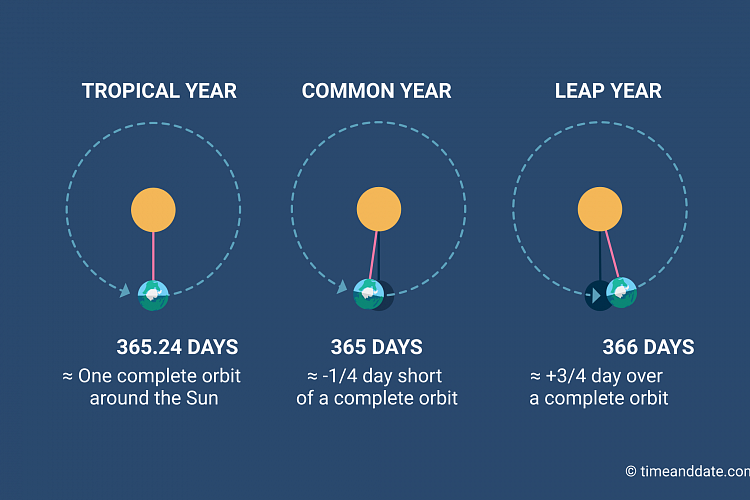
Leap years have 366 days, not 365.
Is 2020 a Leap Year?
Yes, the next leap day is February 29, 2020.
The previous leap day was February 29, 2016.
Why Do We Have Leap Years?
We need leap years to keep our modern-day Gregorian calendar in alignment with Earth's revolutions around the Sun.
It takes Earth approximately 365.242189 days, or 365 days, 5 hours, 48 minutes, and 45 seconds, to circle once around the Sun. This is called a tropical year, and astronomers measure this from the March equinox.
However, the Gregorian calendar has only 365 days in a year. If we didn't add a leap day on February 29 nearly every four years, we would lose almost six hours off our calendar every single year. After only 100 years, our calendar would be off by around 24 days!
Is There a Perfect Calendar?
Leap Year Rules
We add a leap day on February 29, almost every four years. The leap day is an extra, or intercalary, day and we add it to the shortest month of the year, February.
How to Calculate Leap Years
In the Gregorian calendar, three criteria must be taken into account to identify leap years:
The year can be evenly divided by 4;
If the year can be evenly divided by 100, it is NOT a leap year, unless;
The year is also evenly divisible by 400. Then it is a leap year.
According to these rules, the years 2000 and 2400 are leap years, while 1800, 1900, 2100, 2200, 2300 and 2500 are NOT leap years.
Special Leap Year 2000
The year 2000 was somewhat unique as it was the first instance when the third criterion was used in most parts of the world since the start of the transition from the Julian calendar to the Gregorian in 1582.

Julius Caesar introduced leap years.©bigstockphoto.com
Who Invented Leap Years?
Roman general Julius Caesar introduced the first leap years over 2000 years ago. But the Julian calendar had only one rule: any year evenly divisible by four would be a leap year.
This formula produced way too many leap years. Still, it was not corrected until the introduction of the Gregorian calendar more than 1500 years later.
Leap Months
The ancient Roman Calendar added an extra month every few years to maintain the correct seasonal changes, similar to the Chinese leap month.
What Is a Leap Second?


No comments:
Post a Comment