Search For Jobs, News, & Business Tips

Thursday, March 22, 2018

300,000 Troops Will Soon Train for War With North Korea (But There's A Big Catch)

source: nationalinterest


. Although the two allies said they would be “similar in scale” to last year’s war games, they will be shorter in duration.

300,000 Troops Will Soon Train for War With North Korea (But There's A Big Catch)

Washington and Seoul have announced that their annual joint military drills will commence from April 1, while a massive diplomat effort is underway to lay the foundations for two summits designed to resolve issues on the troubled peninsula.

The military drills, involving over 300,000 troops, were delayed because of the 2018 Winter Olympiad, which finished when the Paralympics concluded on March 18. An intensive inter-Korean dialog on the sidelines of the Games resulted in plans for an inter-Korean summit and – according to a South Korean delegation which went to Pyongyang – a promise from North Korean leader Kim Jong-un to suspend nuclear and missile tests and to convene a summit with US President Donald Trump.

All players are engaged in a flurry of diplomatic activity ahead of the inter-Korean summit set for late April, and a North Korea-US summit set for May.

No exact dates for either summit have been announced, though the inter-Korean meeting in late April will take place in the southern zone of Panmunjeom, the truce village in the Demilitarized Zone between the two Koreas.

However, it is not even clear yet on which continent the historic meeting between Kim and Trump will be held.

Military drills shortened

Details of this year’s drills were announced in Washington late on Monday evening, and on Tuesday in Seoul, agencies in both capitals reported. Although the two allies said they would be “similar in scale” to last year’s war games, they will be shorter in duration.

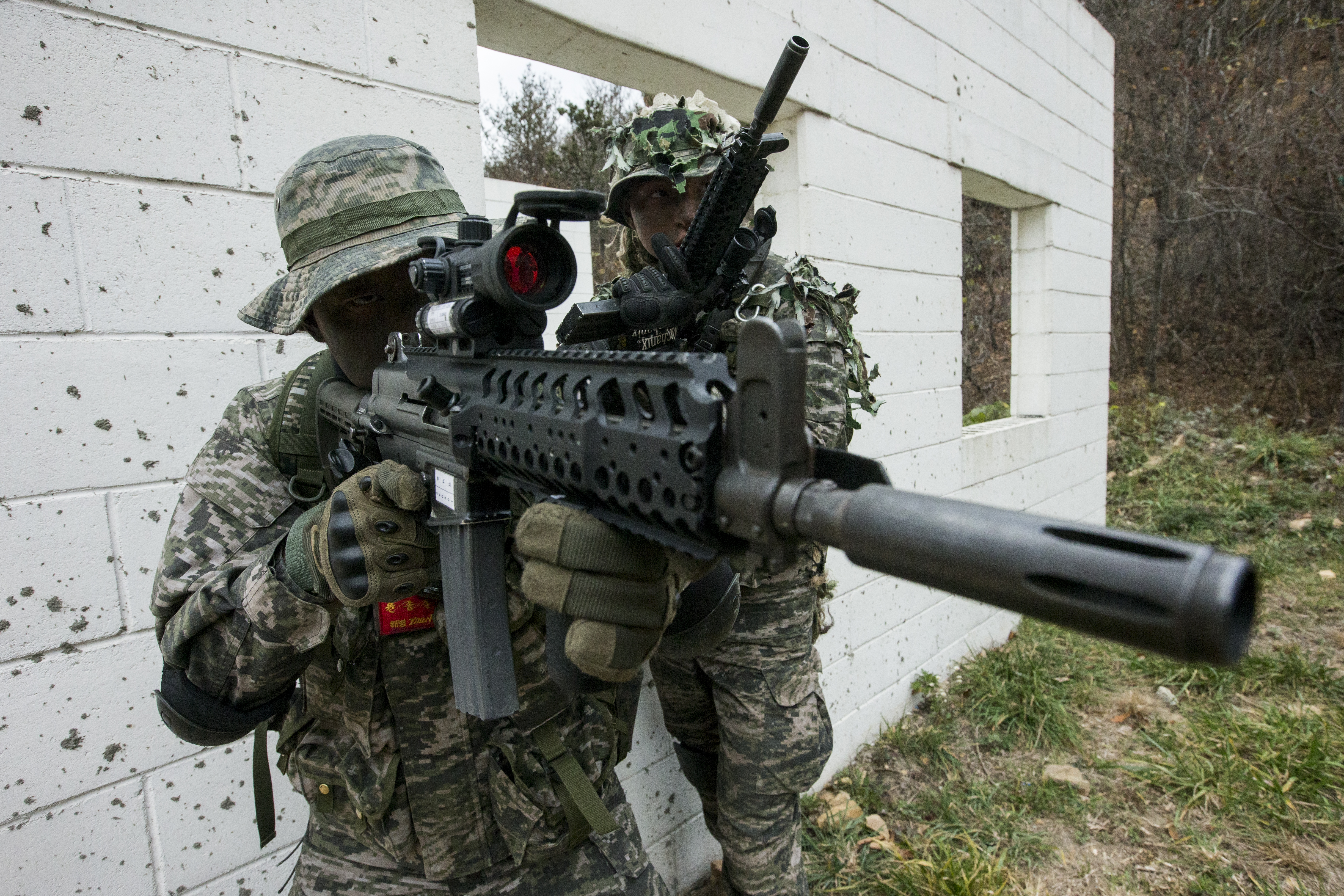
US military newspaper Stars and Stripes reported that the ‘Foal Eagle’ drill will begin on April 1 and run for a month. The exercise is actually a boots-on-the-ground drill that usually involves over 300,000 troops and includes marine landings and live-fire artillery and air strikes. ‘Key Resolve’, a computerized command post exercise, would begin on April 23 and last for two weeks, the US military newspaper added.

Last year, ‘Foal Eagle’ ran for two months from March 1, while ‘Key Resolve’ ran for two weeks from March 8.

However, South Korea’s semi-official Yonhap Newswire stated that the two allies have, in fact, left the ‘Key Resolve’ dates flexible because of the anticipated Kim-Trump summit.

“Initially, South Korea and the U.S. planned to start ‘Key Resolve’ on April 23 but it was rescheduled to mid-April,” an informed source told the newswire. “It’s relatively easy to adjust the schedule of ‘Key Resolve’ as it’s largely computer simulated. It will depend on whether and when the Kim-Trump summit will be held.”

If the Yonhap source proves correct, ‘Foal Eagle’ will overlap with the Kim-Moon summit, but neither exercise will clash with the mooted Kim-Trump summit.

It is not known what hardware and units Washington may dispatch to the peninsula this year to beef up the 28,500 troops stationed in South Korea. Big ticket offensive assets such as aircraft carriers, strategic bombers and even elements of the elite SEAL Team 6, which famously assassinated Osama Bin Laden, have all visited the peninsula in recent years.

Frenzied diplomatic game

Following the Winter Olympics thaw, during which North Korean performers, cheerleaders and taekwondo demonstrators visited the South, South Korean cultural and sports delegations will soon head to the North. From March 31 to April 3 a 160-strong South Korean cultural delegation, including K-pop singers, will hold performances in North Korea, TV news reports said. A South Korean taekwondo team will also head to North Korea for demonstrations and joint performances in the first half of April.

North Korean Foreign Minister Ri Yong-ho held three days of high-level meetings in Sweden last week. “The foreign ministers discussed opportunities and challenges for continued diplomatic efforts to reach a peaceful solution to the conflict as well as bilateral relations,” the Swedish Foreign Ministry said after talks wrapped up, according to Reuters. Stockholm has been tight-lipped on the content of the meetings, but Sweden, which maintains a large embassy in Pyongyang, has traditionally acted as a proxy for US diplomatic interests in North Korea.

Meanwhile, CNN reports that Sweden is helping to negotiate the release of three US citizens currently being held in North Korean prisons.

So-called “1.5 Track” meetings – an unusual channel in which American academics, Korea watchers and retired diplomats meet with serving North Korean diplomats behind closed doors – will take place in Finland this week. Leading the North Korean delegation is North Korea’s point man for US affairs, Choe Kang-il, and South Korean officials will also be present at the meeting, AP reported.

US National Security Adviser H R McMaster met his South Korean and Japanese counterparts in San Francisco for talks over the weekend on denuclearization, South Korea announced said in a statement. Topics discussed included both the inter-Korean and North Korea-US summits.

South Korean Foreign Minister Kang Kyung-Hwa has a particularly full dance card. Following a lightning trip to the United States from March 15-17, when she met officials from Congress, the State Department and media, she has gone to Brussels for European Union ministerial meetings to discuss cooperation on the North Korean nuclear issue. She also met the NATO Secretary-General Jens Stoltenberg and the EU Council.

Even so, the fast-approaching summit between Trump and Kim may go ahead without a clear agenda. Set for May, but with no exact date, no location or agenda beyond “denuclearization” yet decided, Kang said the personal chemistry between the two leaders could be key.

“I think it would be hard, time-wise, to draw up a detailed (denuclearization) roadmap before the North Korea-U.S. summit,” Kang said in an interview in Brussels with Yonhap News Agency. “I suppose that through an agreement on the overall outline between the leaders, there will be a future direction and timetable shaping up.”

In yet another diplomatic huddle, South Korea and the International Atomic Energy Agency (IAEA) will meet this week to discuss North Korea’s nuclear issue and nonproliferation, the foreign ministry told a regular briefing on Tuesday. North Korea demanded in 2002 that IAEA inspectors leave the country.

This first appeared in AsiaTimes here.

Image: Creative Commons.


Latest World News: China Acknowledges Sale Of Advanced Missile Technology To Pakistan


China has sold Pakistan an advanced tracking system that could boost Islamabad's efforts to improve ballistic missiles capable of delivering multiple warheads, according to The South China Morning Post. The website of the Chinese Academy of Sciences (CAS) announced the deal with Pakistan and Zheng Mengwei, a researcher with the CAS Institute of Optics and Electronics, confirmed to the Post that the purchase was of a "highly sophisticated large-scale optical tracking and measurement system." "An optical system is a critical component in missile testing. It usually comes with a pair of high-performance telescopes equipped with a laser ranger, high-speed camera, infrared detector and a centralised ...  Click Here To Read More>>>

Chinese Warship Sails Through Taiwan Strait After President Xi Threatens 'Punishment'


China sailed an aircraft carrier through the Taiwan Strait yesterday, shortly after President Xi Jinping threatened Taipei with ‘punishment’ for splitting the country at the National People’s Congress (NPC).

Taiwan’s Ministry of National Defense (MND) said the Liaoning, a type 001 aircraft carrier, was detected in its waters on Tuesday night, but had disappeared from Taipei’s air defense identification zone by midday Wednesday, according to Reuters.

Yen The-fa, Taiwan’s Defense Minister, claimed that the Liaoning entered the Taiwan Strait—which is divided between Taiwanese and Chinese waters—after conducting drills in the East China Sea earlier this week. He added that military ships were sent to monitor the warship and found nothing out of the ordinary that should be of immediate concern to Taipei.


China's aircraft carrier Liaoning sails past Lamma island (top) as it arrives in Hong Kong on July 7, 2017. On Wednesday, Taiwan's defense ministry revealed that China sent an aircraft carrier through the Taiwan Strait just after President Xi Jinping warned Taipei it will face 'punishment' for separating the country. Getty

Earlier on Tuesday, Xi warned Taiwan that any efforts to split China is “doomed to fail” and will invite “the punishment of history,” during a half-hour nationalistic speech at the closing session of the NPC.

Xi’s comments were also a warning to the U.S. and came shortly after President Donald Trump signed the Taiwan Travel Act, which encourages high-level official visits between Taiwan and America.

The Chinese Embassy in Washington heavily condemned the legislation for ignoring Beijing’s “one-China” policy and said it “severely violates” the “political foundation of the China-U.S. relationship.”

The Liaoning sailed through the narrow Taiwan Strait, that separates the self-ruled island from the mainland, twice in January, sparking fears of a hostile takeover. The waters are an extremely sensitive military zone, despite being routinely travelled by commercial shipping and flights.

Last December, China’s military drills around Taiwan escalated. Despite Beijing’s claims that they were routine, Taipei said they posed an “enormous threat” to its national security.

Taiwan became a self-governed island in 1949, although it is still officially considered the Republic of China. Chinese Communist leaders have wanted to regain the wayward province since the People’s Republic was founded almost 70 years ago and has never renounced the use of force to bring it under its control.

The Washington Free Beacon reported last October that newly disclosed internal military documents revealed that Beijing intends to invade the island by 2020.

This article was first written by Newsweek.


Latest World News: Here Are the 8 Dangerous Masterminds Behind North Korea’s $3 Billion Nuclear Warfare Arsenal


Here Are the 8 Dangerous Masterminds Behind North Korea’s $3 Billion Nuclear Warfare Arsenal

Jang Chang Ha is in his early 50s and is the president of North Korea’s Academy of National Defense Science. Jang seems to be the most elusive of Kim’s crew, making him a man of great interest.
continue Reading>>>

The Latest: 6 Jobs That Probably Won’t Be Around in 10 Years


Whether you’re trying to figure out a career path tailored to your abilities, or just curious of the kinds of jobs that society is slowly fading out, Boss Girl has the rundown on the 6 jobs that probably won’t be around in 10 years time. Technology and cultural shifts have given rise to new careers while slowly making others disappear. Read on to find out which 6 jobs are going obsolete, and why you should avoid them!


Retail Cashier


With the influx of self-service checkouts, and automated processes during purchasing, the typical retail cashier will eventually fade away as a career. Technology has allowed plenty of advancements in how we shop, and customers are wanting less human interaction.


Telemarketer


Nowadays, people don’t use the phone as much as they used to. With other more efficient ways of communicating – such as email or texting. Old fashioned telemarketing is slowly becoming a job of the past. With email marketing on the rise, these once common jobs will no longer be found.
 
Travel Agent


With the rise of the internet and the ability to book trips for cheap using sites comparable to travel agents, this old-school job is slowly fading out of the system. Gone are the days where we need a third party person to find the better deals when travelling, because the internet has made that ability so much easier for us.

Taxi driver


Ride sharing apps have created a new normal for the way the average person acquires transportation. Calling for a cab is going to be non-existent with the rise of apps with GPS technology. Taxi drivers will have to follow the trend in order to keep their business afloat.

Publishers and Printers


It’s no surprise that print media is fading out of the industry. More and more consumers are going digital when it comes to entertainment and news. Publishing companies have been having a hard time keeping up with the times. These industries are slowly fading out to give rise to new digital media companies.


Postal Workers


With the rise of technology and email communication, the need for postal workers has slowly been dwindling away. With the rise of private companies taking the Post Office’s place, this government-run job has little chance for career growth and advancement.


6 Jobs That Probably Won’t Be Around in 10 Years-Amust Read


Whether you’re trying to figure out a career path tailored to your abilities, or just curious of the kinds of jobs that society is slowly fading out, Boss Girl has the rundown on the 6 jobs that probably won’t be around in 10 years time. Technology and cultural shifts have given rise to new careers while slowly making others disappear. Read on to find out which 6 jobs are going obsolete, and why you should avoid them!


Retail Cashier


With the influx of self-service checkouts, and automated processes during purchasing, the typical retail cashier will eventually fade away as a career. Technology has allowed plenty of advancements in how we shop, and customers are wanting less human interaction.


Telemarketer


Nowadays, people don’t use the phone as much as they used to. With other more efficient ways of communicating – such as email or texting. Old fashioned telemarketing is slowly becoming a job of the past. With email marketing on the rise, these once common jobs will no longer be found.
 
Travel Agent


With the rise of the internet and the ability to book trips for cheap using sites comparable to travel agents, this old-school job is slowly fading out of the system. Gone are the days where we need a third party person to find the better deals when travelling, because the internet has made that ability so much easier for us.

Taxi driver


Ride sharing apps have created a new normal for the way the average person acquires transportation. Calling for a cab is going to be non-existent with the rise of apps with GPS technology. Taxi drivers will have to follow the trend in order to keep their business afloat.

Publishers and Printers


It’s no surprise that print media is fading out of the industry. More and more consumers are going digital when it comes to entertainment and news. Publishing companies have been having a hard time keeping up with the times. These industries are slowly fading out to give rise to new digital media companies.


Postal Workers


With the rise of technology and email communication, the need for postal workers has slowly been dwindling away. With the rise of private companies taking the Post Office’s place, this government-run job has little chance for career growth and advancement.


Latest World News: How Israel Takes America's Best Weapons of War and Makes Them Even Better


The Israel Defense Forces field a wide variety of American military equipment, due to significant amounts of American military aid to Israel. However, American equipment has not always been the best suited to the tough desert and urban conditions encountered by the IDF. As a result, American equipment in Israeli service is often extensively modified to fit the IDF’s unique mission. Here are some unique derivatives of American equipment that the IDF fields.

1. MAPATS Antitank Missile

The IDF has had a long relationship with the antitank guided missile. In the long desert approaches that surround Israel, antitank missiles can direct the flow of combat and are very effective weapons. While the first ATGMs fielded by Israel were the French SS.10 and SS.11, it was replaced in the late 1970s by the American TOW (Orev in IDF service) missile. However, due to its wire-guided nature, the TOW has range limitations and cannot be used in all circumstances. Bodies of water, trees and power lines can disrupt the TOW’s guidance or endanger the TOW’s operator. As a result, the Israelis developed a version of the TOW that used laser guidance to avoid these issues. A new engine and improved warhead also gave it superior penetration and speed to the original TOW. The MAPATS has seen export success, although it is being replaced by other, newer Israeli ATGMs of wholly indigenous design.

2. Israeli M16 and CAR-15 Variants

While nominally most of the IDF has switched over to the Tavor, variants of the M16 continue to serve in the IDF. However, in the late 1980s and 1990s, these rifles were the frontline rifles of the IDF, replacing the heavier FN FAL and the Israeli Galil (although Galil carbines remained in service in the Armored corps, due to their shorter lengths with stocks folded).

In the aughts, Israel set about modernizing these rifles. Due to the largely urban nature of combat the IDF Infantry engaged in, the long twenty-inch and 14.5-inch barrels of the M16s and Colt 653s were deemed too long. The barrels were sawn off to around 12.5 inch length, and the resulting carbines were called “mekut’zrar.” Furniture on these varied, but always had an eye towards the practical. Fabric bands could be wrapped around the plastic handguards to make them more rigid and stop them from creaking, red dots were added straight onto the carry handles and stocks were often replaced with modern six-position M4 stocks. The results were relatively modern, lightweight carbines on the cheap. Mekut’zrar carbines are still seen in service today, although they’ve been supplanted by new stocks of M4s and the Tavor series.

3. Machbet Self-Propelled Antiaircraft Gun


While the M163 VADS was always considered to be kind of a “stopgap” solution for the short-range antiair defense solution for the U.S. military, the VADS saw significant Israeli service in the 1982 Lebanon War. In addition to scoring a kill on a Syrian MiG-21, they provided valuable ground support, suppressing infantry in urban and mountainous areas with their rapid-fire twenty-millimeter cannons. While they were phased out of American service in the 1990s and replaced with the better-armored but slower-firing M6 Bradley Linebacker, Israel opted to upgrade its VADS to the new “Machbet” standard instead, fitting an optoelectronic tracking system, better radar, a quad-Stinger pod and an ADA network datalink to the VADS to make it effective against a wider variety of targets and faster reacting.

4. The F15 Baz Meshopar
Israel was one of the first customers for the American F-15 fighter. It has served admirably as the backbone of the Israeli Air Force (IAF) throughout the late 1970s to the present day. In addition to its superb performance in the air-to-air role during the 1982 Lebanon War, the F-15 was also used in Operation Opera and Operation Wooden Leg, both long-range-strike missions.

These were done with the addition of some indigenous guidance and sensor pods. While Israel later acquired variants of the ground-attack F-15E Strike Eagle under the name F15I Ra’am, they also updated their first- and second-gen F-15s to a new standard with indigenous electronics and parts, under the name F-15 Baz Meshopar, or Baz 2000. The upgrade included a new radar with AIM-120 and Israeli Python missile compatibility, redone cockpits with a new throttle and stick and glass cockpit, and improved electronic-warfare capability. This upgrade program ran from 1995 to 2001, and these upgraded F-15s are expected to continue to serve far into the future.

Charlie Gao studied political and computer science at Grinnell College and is a frequent commentator on defense and national-security issues.

Image: Wikimedia Commons

source: nationalinterest


Latest World News: Could America Stop a Cruise Missile or Hypersonic Weapons Attack by Russia or China?


The Defense Department is looking at ways to prevent an enemy from being able to launch a weapon in the first place.

Could America Stop a Cruise Missile or Hypersonic Weapons Attack by Russia or China?

With Russia and China developing advanced cruise missiles and weapons such as hypersonic boost-glide vehicles, the United States is looking at ways to defeat threats other than incoming intercontinental ballistic missiles. Moreover, the Pentagon recognizes that it might not be able to stop an incoming missile before it launches, thus the Defense Department is looking at ways to prevent an enemy from being able to launch a weapon in the first place.

“The Department is conducting a 2018 Missile Defense Review (MDR),” Gen. John E. Hyten, commander of U.S. Strategic Command told the Senate Armed Services Committee on April 4 in his written testimony. “The MDR is broader in scope than the 2010 Ballistic Missile Defense Review, addressing more than the ballistic missile threat, specifically hypersonic vehicles and cruise missiles.”

Hyten’s reasoning was that adversaries are increasingly developing sophisticated weapons to counter America’s existing missiles defenses.

“Missile proliferation and lethality continues to increase as more countries acquire greater numbers of missiles and are increasing their technical sophistication specifically to defeat U.S. missile defense systems,” Hyten wrote. “In the past year, we continue to see missile tests from North Korea and Iran as well as other nations that are introducing increasingly sophisticated missiles – all of which cause us and our allies deep concern.”

Hyten framed the development of adversary missile capabilities as a challenge to American power, which has until relatively recently gone largely unchallenged since the collapse of the Soviet Union in 1991.

“Their efforts to advance missile technologies threaten global stability and seek to degrade our ability to project power,” Hyten said.

In Hyten’s view, the danger from advanced missiles is so great that active attempts at interception are no longer enough.

“We cannot be successful in this endeavor by investing solely in active missile defense capabilities – we must strengthen and integrate all pillars of missile defense including the capability to defeat adversary missiles before they launch,” Hyten said. “We are exploring efficiencies gained by fusing non-kinetic, cyber, electromagnetic, and kinetic capabilities to deny, defend, and defeat adversary threats.”

But while engaging an enemy launch vehicle is one thing, the Pentagon needs to get better at finding an enemy missile in the first place.

“Furthermore, we are requesting additional efforts invested in the Department’s ability to find, fix, track, target, engage, and assess (F2T2EA) threats and the adoption of corresponding policy and organizational constructs,” Hyten said. “We continue to gain synergy through integrated missile defense planning, force management, and operations support ensuring global coordination of regional missile defense execution – thereby, matching the best interceptor with the best sensor.”

The Pentagon also hopes to work with U.S. allies to help defend against incoming ballistic missiles. Some of the Pentagon’s efforts include hosting wargames.

“We must strengthen our collaboration with our allies and explore further integration of our collective capabilities toward an effective mutual defense,” Hyten said. “We are investing in collaboration with our allies across multiple venues, including the USSTRATCOM-hosted NIMBLE TITAN wargame. We conduct this biennial wargame with key allies and in partnership with the Department of State and other combatant commands. We continually explore and experiment with potential collaboration and integration approaches with our allies to inform development of options for operations, policies, and investment.”

It remains to be seen how Stratcom and the Missile Defense Agency’s efforts pan out. Most of the Pentagon’s efforts to defeat intercontinental ballistic missiles have not performed as nearly well as advertised.

Dave Majumdar is the defense editor for The National Interest. You can follow him on Twitter: @davemajumdar.
More on newsweek>>>


Lates World News: Turkey Is Launching the Next Middle East War With Attacks on Kurds in Iraq and Syria

source: newsweek


The U.S. and Turkey have offered conflicting statements as to whether Washington had agreed to allow Ankara to expand its war against Kurdish fighters operating alongside U.S. Special Forces in Syria. Meanwhile, new Turkish airstrikes targeted other Kurdish fighters in Iraq on Wednesday, signaling a new phase of conflict in two nations still reeling from being partially overtaken by the Islamic State militant group (ISIS).

Ibrahim Kalin, a spokesman for Turkish President Recep Tayyip Erdogan, initially told Al Jazeera on Monday that his government had reached a general agreement with the U.S., one that would allow Turkish forces and their Syrian rebel allies to expand an offensive against Syrian Kurdish fighters across northern Syria. The U.S. has trained and equipped a number of these Kurdish groups, including the People's Protection Units (YPG), in order to fight ISIS as part of the larger Pentagon-backed Syrian Democratic Forces.


Turkey, however, has argued these Kurdish groups are linked to the militant Kurdistan Workers' Party (PKK) that has launched a decades-long separatist insurgency against Ankara. Turkey launched an invasion of Syria in January to oust the YPG from the northwestern Syrian city of Afrin. On Sunday, nearly two months later, they succeeded, and Erdogan has plans of continuing the operation to other Kurdish cities such as Manbij, where U.S. forces are supporting their Kurdish allies.

In response to Kalin's suggestion that the U.S. had agreed to move these troops or order them to stand down in the event of a Turkey-backed attack, State Department spokeswoman Heather Nauert told reporters Tuesday, "That’s funny, because no agreement has been reached."

After speaking with outgoing Secretary of State Rex Tillerson on Wednesday, Kalin clarified, saying they had reached "an understanding," not an agreement, as Turkish troops and insurgent Free Syrian Army fighters advanced closer to U.S. military positions in northern Syria, according to Turkey's Daily Sabah.


A tank belonging to Turkish soldiers and rebel Free Syrian Army fighters is seen in the Kurdish-majority city of Afrin, in northwestern Syria, after they took control of the city from the Kurdish People’s Protection Units (YPG), on March 18. Turkish flags adorned local buildings in the city, signaling a potential long-term presence. OMAR HAJ KADOUR/AFP/Getty Images

Not wanting to risk its partnership with fellow NATO member Turkey, the U.S. has so far declined to get involved in the Afrin operation, but its cost Washington the trust of its leading ally on the ground in Syria. Kurdish fighters of the Syrian Democratic Forces active in the fight against ISIS in eastern Syria have redeployed en masse in an attempt to defend Afrin, and now other Kurdish cities in the north.

It has also established an unlikely alliance of local actors whose tensions far predate the ongoing civil war. Kurds have accused Syrian President Bashar al-Assad of oppressing their cultural and political aspirations in the country, and the Baathist leader's father actually expelled PKK leader Abdullah Öcalan to Turkey in 1998, a year before Öcalan was arrested by Turkey and two years before the senior Assad's fatal heart attack placed his youngest son in power.

Turkey went on to join the West and Gulf Arab states in backing the 2011 uprising against Assad, however, and Syrian Kurds have since been alienated by an increasingly jihadi opposition. Last month, Syrian Kurds appealed to Assad for help and a number of pro-government National Defense Forces units were sent to the region to fight.

While Syria has yet to fully open a new front against the Turkish incursion, it has appealed to the United Nations Security Council, which has been more focused recently on criticizing Assad's violent offensive against other pockets of rebel groups that continue to launch deadly rocket attacks on Damascus. Russian and Iranian support has allowed the Syrian military retake control of vast swathes of the country, leaving only bastions of insurgent control and large sections of the north under Syrian Democratic Forces administration.


A map shows areas of control in Syria as of March 20. Turkish President Recep Tayyip Erdogan has threatened to expand his war on Kurdish groups with alleged Kurdistan Workers’ Party (PKK) links across six cities in Syria and Iraq. Institute for the Study of War

If Turkey and its rebel allies swept through the Kurdish heartland of northern Syria, they would come across U.S. military bases established to defend Kurds against ISIS, and the Pentagon has offered no indication that its forces would step aside.


The rise of jihadi Sunni Muslim groups in the aftermath of the U.S. invasion of Iraq 15 years ago left the country's border with Syria permeable. As unrest gripped Syria as well, the former Al-Qaeda-affiliate Islamic State of Iraq used this as a platform to spread across the border under the banner of ISIS in 2013. The following year, it took over about half of both Iraq and Syria.

In Syria, ISIS faced a pro-Syrian government campaign by the military, Russia and a number of mostly Iran-backed militias as well as the U.S.-led coalition campaign spearheaded by the Syrian Democratic Forces. In Iraq, the U.S.-led coalition supported Kurdish forces and the Iraqi military, which fought alongside other Iran-backed militias. Last year, both the Iraqi and Syrian governments declared ISIS effectively defeated.

Early this year, Iraq and Syria have expressed concern about Turkey, which has also begun conducting airstrikes against Kurdish fighters in northern Iraq. While the Syrian government outright considered the U.S. and Turkish military to be invaders in the country due to their support for insurgents throughout the war, the Iraqi government has maintained better ties.


Turkish troops sweep the Kani Rash area of northern Iraq in an operation against suspected Kurdistan Workers’ Party (PKK) militants, on March 21. Iraq and Syria have both called for Turkish troops to immediately withdraw from their countries. Turkish Armed Forces

Iraq has agreed to work with Turkey against suspected PKK-aligned groups, but it has warned that Ankara must do so with Baghdad's approval. Iraqi Foreign Minister Ibrahim al-Jaafari told his Turkish counterpart on Wednesday that he hoped to develop better relations between the two nations, but called for an end to unsanctioned Turkish attacks on Iraqi Kurds and a withdrawal of Turkish troops from northern Iraq.

"While we give importance to the depth of Iraqi-Turkish relations, we categorically reject violations of Iraq's borders by Turkish forces, and re-emphasize the need to withdraw of Turkish troops from the city of Bashiqa," Jaafari said, according to an Iraqi Foreign Ministry statement.


Latest World News: As Putin Threatens U.S. With 'Satan 2' Nuke, Trump Says He Doesn't Want An Arms Race


President Donald Trump and Vladimir Putin agreed that neither leader want an arms race just weeks after Russia unveiled a new generation of weapons of mass destruction, including a hypersonic intercontinental ballistic missile called “Satan 2” by NATO.

Trump called Putin to congratulate him after he secured another six-year term in a March 18 election international observers said was marred by “irregularities” and a “lack of genuine competition”.

"In their conversation the two leaders agreed that any arms races would be undesirable," Russian presidential spokesman Dmitry Peskov said, reported TASS, a Moscow-based news agency.


Vladimir Putin Satan 2

Russian President and Presidential candidate Vladimir Putin at a polling station during the presidential election in Moscow, Russia March 18, 2018. Sergei Chirkov/POOL via Reuters

The Kremlin's conclusion after the Trump call, Peskov said, was: "Washington had turned an attentive ear to the president’s message to the Federal Assembly and the later statements that Russia has no intention to be dragged into an arms race."

But just weeks earlier Putin used his annual presidential address to reveal the development of a new generation of Russian weapons, including a hypersonic intercontinental ballistic missile called the RS-28 Sarmat, or Satan 2.

He boasted that the weapon is so fast it could evade U.S. missile defenses and showed a video demonstrating the Satan 2's capabilities—including it striking what looked to be Florida.

Russia claims Satan 2, which weighs over 200 tonnes, can carry a payload devastating enough to wipe out an area the size of Texas. The White House did not respond to the video simulation.

Putin said other countries only listen to Russia when it creates new weapons systems. “You will listen to us now,” he warned.

The U.S. and Russia are committed by international treaties to nuclear nonproliferation. But both countries maintain and update vast stockpiles of apocalyptic weapons.

According to the Arms Control Association, Russia has 1,444 deployed nuclear warheads, 4,500 stockpiled warheads, and 2,510 retired warheads, taking the total to around 7,010.

The U.S. has 1,350 deployed nuclear warheads, with around 4,000 stockpiled and 2,550 retired, making America's total 6,550 weapons.

This article was first written by Newsweek


Latest World News: Chinese paper says China should prepare for military action over Taiwan


FILE PHOTO: Members of the National Security Bureau take part in a drill next to a national flag at its headquarters in Taipei, Taiwan, November 13, 2015. REUTERS/Pichi Chuang


By Ben Blanchard

BEIJING (Reuters) - A widely read Chinese state-run newspaper said on Thursday China should prepare for military action over self-ruled Taiwan, and pressure Washington over cooperation on North Korea, after the United States passed a law to boost ties with Taiwan.

Beijing was infuriated after U.S. President Donald Trump signed legislation last week that encourages the United States to send senior officials to Taiwan to meet Taiwanese counterparts and vice versa.

U.S. Deputy Assistant Secretary of State Alex Wong said in Taipei on Wednesday the United States' commitment to Taiwan has never been stronger and the island is an inspiration to the rest of the Indo-Pacific region.

China claims Taiwan as its own and considers the self-ruled island a wayward province, which Chinese President Xi Jinping said on Tuesday would face the "punishment of history" for any attempt at separatism.

The Global Times said in an editorial China had to "strike back" against the law, for example by pressuring the United States in other areas of bilateral cooperation like over North Korea and Iran.

"The mainland must also prepare itself for a direct military clash in the Taiwan Straits. It needs to make clear that escalation of U.S.-Taiwan official exchanges will bring serious consequences to Taiwan," said the paper, which is published by the ruling Communist Party's official People's Daily.

"This newspaper has suggested that the mainland can send military planes and warships across the Taiwan Straits middle line. This can be implemented gradually depending on the cross-Straits situation," it said.

Underscoring China's concerns, Taiwan's government and the de facto U.S. embassy on the island said a second senior U.S. official would be visiting Taiwan this week, Deputy Assistant Secretary of Commerce for Manufacturing Ian Steff.

In Beijing, foreign ministry spokeswoman Hua Chunying reiterated China's opposition to official contacts between the two, urging people to reread Xi's comments from earlier in the week.

"The Chinese people share a common belief that it is never allowed, and it is absolutely impossible, to separate any inch of our great country's territory from China," Hua said, quoting Xi.

The island is one of China's most sensitive issues and a potential military flashpoint. Underlining that threat, Taiwan sent ships and an aircraft earlier on Wednesday to shadow a Chinese aircraft carrier group through the narrow Taiwan Strait, its defense ministry said.

China's hostility toward Taiwan has risen since the 2016 election of President Tsai Ing-wen, a member of the island's pro-independence Democratic Progressive Party.

China suspects Tsai wants to push for formal independence, which would cross a red line for Communist Party leaders in Beijing, though Tsai has said she wants to maintain the status quo and is committed to ensuring peace.

(Reporting by Ben Blanchard; Additional reporting by Fabian Hamacher and Twinnie Siu in TAIPEI; Editing by Paul Tait and Clarence Fernandez)

Here's what the US should do if Russia launched a nuclear attack, according to the US nuke commander


Here's what the US should do if Russia launched a nuclear attack, according to the US nuke commander

Air Force Gen. John Hyten says he would not recommend an immediate response if nuclear-tipped missiles were headed for the U.S.
Hyten says a nation would have 30 minutes to react to an incoming threat.
He urges lawmakers to consider the Pentagon's request to add new low-yield nuclear weapons to its arsenal.

The Air Force general in charge of America's nuclear arsenal provided a rare glimpse into what he would do if Russia launched two nuclear-tipped ballistic missiles at the United States.

His take might be surprising to some.

Gen. John Hyten told lawmakers this week that the U.S. should not retaliate until incoming missiles had reached their targets or were destroyed in-flight by defense systems.

"If we do have to respond, we want to respond in kind and not further escalate the conflict out of control," Hyten, the commander of U.S. Strategic Command, told the Senate Armed Services Committee on Tuesday.

He added that the window for detecting the missiles is "a very short period of time."

"From detection to the creation of the explosion is less than 30 minutes," the four-star general said.

Hyten noted that if the missiles did not pose an existential threat, then the U.S. would not then have to respond with an existential threat. "That's what I would recommend if I saw that coming against the United States," he said.

While Hyten recommended a measured response in such a scenario, he urged lawmakers to consider the Pentagon's request to add new nuclear weapons to its arsenal.

"I strongly agree with the need for a low-yield nuclear weapon," Hyten said in regard to submarine-launched warheads. "That capability is a deterrence weapon to respond to the threat that Russia, in particular, is portraying."

Lawmakers questioned Hyten on whether adding more nuclear warheads would escalate tensions. The commander then quoted former Secretary of State and National Security Advisor Henry Kissinger and said that without the right response options, the U.S. president would be choosing between "suicide or surrender."

"Suicide if you escalate too high and the escalation comes back at you. Surrender if you don't have the ability to respond," Hyten explained. "And so, an adversary — Russia in this case — will see a weapon coming ... but they don't have to respond right now, and they won't have time to respond because they won't want to commit suicide."

He continued by saying that the primary mission of nuclear warheads is deterrence and not to start a nuclear war.

"The first use of that weapon is to make sure that nobody uses that kind of weapon against us," Hyten said. "I'd prefer Iran without nuclear weapons. I'd prefer North Korea without nuclear weapons. But I don't think nuclear weapons will ever go away."

Hyten, who has previously called Russia the "most significant threat" to the U.S., also told lawmakers that there is currently no defense againstthe hypersonic weapons Putin is pursuing.

"We don't have any defense that could deny the employment of such a weapon against us." This means that, as of now, the U.S. has to rely on deterrence against these so-called hypersonic weapons, he said.
source: cnbc

Popular Posts

Contact Form

Name

Email *

Message *