Search For Jobs, News, & Business Tips

Monday, February 26, 2018

US Congress faces mounting pressure to act on guns


US President Donald Trump and Congress are mulling possible changes to federal gun laws in the aftermath of a school shooting in Florida that left 17 people dead
US lawmakers returned to Congress Monday under pressure to address the nation's gun violence epidemic following the Parkland mass shooting, as staff make an emotional return to the Florida school where 17 people were killed.

President Donald Trump has called for gun law reform in the wake of the tragedy, including strengthening background checks on firearm purchases, but the White House has yet to announce support for specific legislation in Congress, where enacting federal gun restrictions faces major obstacles.

The Republican leaders in the Senate and House of Representatives have remained largely silent on the matter, with members of their party split on how to proceed.
The vast majority of Democrats want to bring gun control efforts to fruition in Congress, and a new CNN poll showed that 70 percent of Americans support stricter gun laws, up 18 points since October.
Republicans from suburban districts where calls for gun control have swelled have expressed an openness to raising the age limit for purchasing semi-automatic rifles to 21, or banning devices that turn such weapons into machine guns. But many conservative lawmakers consider any action that restricts gun rights as a creeping assault on citizens' constitutional right to bear arms.

The split appeared to leave the prospects of significant new gun legislation in doubt.
"I'm a little bit pessimistic that something will happen," moderate House Republican Charles Dent told CNN Monday.

Dent said enhancing background checks and banning bump stocks "should be no-brainers," but the president's unambiguous support on the issue was still needed.
Trump, who repeatedly touted his Second Amendment credentials on the 2016 campaign trail, has said he is open to raising the minimum age for gun purchases and to banning bump stocks, which were not used in the Parkland killings.

The National Rifle Association has opposed some of the proposed gun measures.
Trump wants to see security boosted at US schools, and has promoted the idea of arming some teachers and staff in addition to on-campus guards.
Speaking at the Governors' Ball ahead of meetings with the top officials from all 50 states on Monday, Trump said school safety is a top priority: "I think we'll make that first on our list."

Source: AFP

Naval Warfare Will Change Forever If Submarines Turn into Underwater Aircraft Carriers


And it seems increasingly likely. 

Naval Warfare Will Change Forever If Submarines Turn into Underwater Aircraft Carriers Imagine a future in which nuclear attack submarines (SSNs) can deploy undersea drones (UUVs) to hunt, and possibly kill, enemy subs. The U.S. Navy, at least, is taking steps to make this a reality. What impact could this have? On the one hand, UUVs could shake modern antisubmarine warfare (ASW) to its core, making existing platforms vulnerable or obsolete. On the other hand, the development of UUVs could reinforce existing hierarchies; in contrast to popular understanding, established organizations are often the best at adapting to disruptive military innovations. The future of the U.S. Navy depends to great extent of which of these becomes a reality.

History
In a sense, submarine launched drones have existed for quite some time; even in World War II, navies used pattern following or acoustic homing in order to find their targets. Wire guided torpedoes were introduced in the 1960s, allowing the submarine a measure of control over how the weapon approached its target. These torpedoes are suicidal drones in the same sense as cruise missiles; weapons that can be launched, then directed to their target either through autonomous mechanisms or by user interface.

Nigeria Government admits missing schoolgirls have been 'abducted'

 
 President Muhammadu Buhari said his government was determined to ensure the release of everyone taken by the Islamist militants and to return "the abducted girls to their families"

More than 100 girls missing for a week after a Boko Haram attack on their school in northeast Nigeria were kidnapped, the government said for the first time on Monday.
The authorities in Abuja had previously stopped short of saying the 110 students were seized during the raid on the Government Girls Science and Technology College in Dapchi last Monday.

The attack has revived painful memories in Nigeria of the mass abduction of 276 girls from another boarding school in Chibok in April 2014. Nearly four years on, 112 are still being held.

President Muhammadu Buhari said his government was determined to ensure the release of everyone taken by the Islamist militants and to return "the abducted girls to their families".
"This is especially against the backdrop of the recent incident where another group of girls were abducted on January 19 from the Government Girls Science and Technical College in Dapchi, Yobe state," Buhari told a reception in Abuja for former captives of jihadists, his office said in a statement.
Buhari added that he had ordered the country's security agencies to ensure the safety of schools and students.

- Shadow of Chibok -

Nigeria's reluctance to admit the kidnapping comes in part due to Chibok, whose shadow hung over the previous administration and many believe contributed to its election loss.
Buhari, a former military ruler, was elected in 2015 on a promise to end the Boko Haram insurgency, which since it started nine years ago has claimed at least 20,000 lives.
The abduction in Dapchi comes after repeated claims from the military and government that Boko Haram was on the verge of defeat.

It has led to questions about the extent of the government's grip on security and why promises to improve security of schools appears not to have been implemented, despite Chibok.

Boko Haram, whose name translates roughly from Hausa as "Western education is forbidden", has repeatedly targeted schools teaching a so-called secular curriculum.
The jihadists want to establish a hardline Islamic state in northeast Nigeria.
It has used kidnapping as a weapon of war, seizing thousands of women and young girls as well as men and boys of fighting age.

- School closed -

Earlier, the education commissioner for Yobe state, Mohammed Lamin, said the school in Dapchi would remain closed as it was "not feasible to reopen (it) in the current situation".

"We still have over 100 girls that are unaccounted for. The other girls that were found are not in the right frame of mind to return to school. They are still in trauma," he told AFP.
Lamin said the school would remain closed "for a while, until the situation normalises and the girls are psychologically prepared to resume".

Buhari said in December 2015 that Boko Haram was "technically defeated" and has called the situation a "national tragedy".

On Friday, parents and locals in Dapchi said they had been left vulnerable to attack because soldiers had been withdrawn in the last few weeks. Yobe state governor Ibrahim Gaidam on Sunday confirmed the lack of military presence but said he was unaware of the withdrawal and drew comparisons to another school attack in the state.

He said troops pulled out of Buni Yadi on the morning of February 25, 2014, allowing jihadists to storm the boys' boarding school, where more than 40 students were killed.
"Despite the fact that the military personnel are trying their best, they need to do more to contain the situation. There is need for a redeployment of troops," added Gaidam.

The military called Gaidam's remarks "misleading". Troops were redeployed to support comrades stationed on the border with Niger, it said in a statement.

"This was on the premise that Dapchi has been relatively calm and peaceful and the security of Dapchi town was formally handed over to the Nigeria police division," it added.

SOURCE: AFP

Is Very Possible Israel and Iran Go to War Next Year


Non-Iranian Militia Mercenaries: Afghan, fifteen thousand to twenty thousand; Pakistan, five thousand to ten thousand; Islamic Revolutionary Guard Corps (IRGC), eight thousand to ten thousand; Iranian Regular Army, five thousand to six thousand, all estimates as of 2016.
If Tehran uses its militias, and other forces drafted to do Iran’s deeds, as well as its IRGC to launch attacks on Israel, there may be war between Israel and Iran by 2019.
We asked in January if 2018 would bring revolution to Iran. Now we ask: Will Israel and Iran go to war by 2019?

By acknowledging the legitimacy of the National Council of Resistance of Iran, it would result in fewer actions by Tehran to crack down on protestors, e.g., by going to war with Israel to divert the Iranian population from domestic unrest.

The lead of the January 17 article was CIA Director Mike Pompeo. He said, “It is my full expectation that you will see the Iranian people continue to revolt against this [crackdown by Tehran on protests.]
Likewise, we lead this article, with Director Pompeo. About Israel and Iran, and North Korea, Pompeo said,

 “Whether it’s Lebanese Hezbollah, the threat that it [Iran] presents to both Lebanon and to Israel; whether it’s the Shia militias—you can see the impact that they're having today, even in northern Iraq; the threat that they pose to U.S. forces.” And even more to the point of our post, Pompeo also said, “There is a long history of proliferation ties, as between North Korea and Iran.” Proliferation partners share technology, making it easier for both to develop ballistic missiles and nuclear weapons.”

Breaking News
Regarding 2018, direct conflict between Israel and Iran is not only on the horizon, but happening now: interception of an Iranian drone over Israel, downing of an Israeli F-16, and retaliatory strikes against Syrian and Iranian targets. These converging events are opening scenes of a wider war—if Tehran continues trying to fortify its presence in Syria after the defeat of Islamic State.

See the threat by Israeli prime minister Benjamin Netanyahu to Iranian foreign minister Mohammad Javad Zarif: “Bibi” said, “Do not test Israel’s resolve,” at the Munich Security Conference on February 18. Zarif has also made threats. He warned Iran would respond “seriously,” if its “interests are not secured.”

Growing tensions between Israel and Iran, show few signs of warmth and may heat up further between 2018 and 2019. But will the countries go to war? And what would this mean for regional peace and security?

The Israeli army’s February 10 announcement that it launched a “large-scale attack” inside Syria on Saturday to target aerial-defense batteries and sites it said were linked to Iran, after one of its aircraft crashed under Syria antiaircraft fire, is a further reminder of the Islamic Republic’s malign regional activities.

There is the “latest sign of rapidly warming relations between estranged neighbors,” North Korea’s Kim Jong-un extended a February 10 invitation to his counterpart in the South—President Moon Jae-in—to commence talks in Pyongyang, just as the 2018 Winter Olympics got underway.

The Backstory

President Donald Trump first placed Tehran on notice for engaging in regional destabilization shortly after taking office in February 2017 and then pursued comprehensive sanctions targeting Iranian ballistic-missile programs in July 2017.

The administration’s October 2017 decision to designate formally the IRGC, as a Foreign Terrorist Organization—effectively blacklisting it and more than forty related entities from the global economy—is necessary to contain the regime’s belligerence.

We’ve Lost the Opening Info Battle against Russia; Let’s Not Lose the War


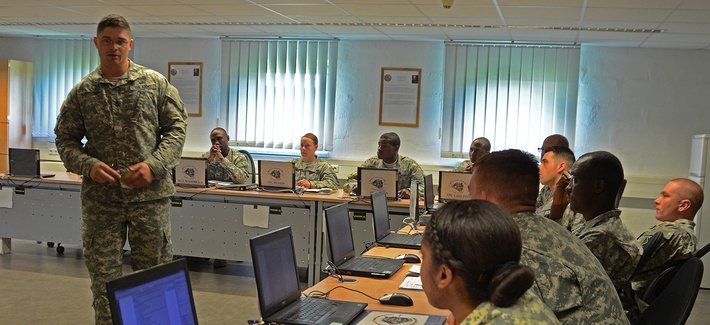
Staff Sgt. Travis Andersen leads a class for WLC students in Bravo Company at the 7th Army NCO Academy in Grafenwoehr, Germany.

The United States has nearly a perfect track record in predicting the nature of the next conflict we will fight: always wrong. That military adage has unfortunately held true in the current conflict being fought in the information domain. The indictment of thirteen Russians by Special Counsel Robert Mueller is just the most recent demonstration that our adversaries are constantly seeking to exploit to our detriment the nature of a more digitized, networked world. In an era where information has never been more plentiful, our adversaries understand that it has also never been more vulnerable to manipulation.

For much of modern history, we have fought wars of iron and silicon in which the outcome hinged on industrial production and the power of the computer chip. Today we confront a new type of conflict: the war of narrative. In this war, cleverly marshalled facts and information—or falsehoods and misinformation—are equally powerful as smart bombs and missiles, and they can be deployed, manipulated, and twisted with far greater ease.

Consider the Russian interference in the 2016 U.S. presidential election that has now been laid bare. The leaders of the U.S. intelligence community have recently testified that the Russians are likewise gearing up to interfere in the 2018 mid-term election later this year, and almost certainly the 2020 presidential election.


For Russian President Vladimir Putin, the main goal is steady degradation of U.S. electoral processes and the tenor of our politics. Whether a specific candidate wins is less important than sowing doubt about the legitimacy of our elections in the minds of both the American people and those overseas who look to American democracy as a model. The Russian campaign includes not only efforts to hack voting machines and electoral rolls, but also the seeding of divisive issues through social media. To counter this insidious campaign, we must understand the underlying motives and methods of our adversary.

In Putin’s Russia, the truth threatens the regime, and, therefore, in a perversion of Winston Churchill’s aphorism, it is obscured at all times by a host of lies. Drawing on his experience as a KGB operative, Putin understands intuitively the power of propaganda, deceit, and false narratives. Misinformation protects his cadre of oligarchs at home, and Putin uses it to delegitimize Western democracies from within. It shrouds the action of “little green men” in Crimea and mercenaries in Syria. Even sport warrants manipulation in Putin’s world, as attempts to glorify Russian athletics at the expense of competitors led to the largest state-sponsored doping scheme in history at the 2014 Sochi Olympics.

The Chinese government also seeks to advance and control its own narrative, albeit more subtly. Domestically the Communist Party exerts extraordinary control over media and the internet, and insists that global social media and technology companies play by its skewed rules to gain access to the lucrative Chinese market. Internationally, China leverages human and cyber intelligence to steal industrial secrets and intellectual property from Western corporations. At home and abroad, China does not hesitate to use its market power to punish other nations and limit academic freedom. In this way the Communist Party both protects is own cult of personality at home, while manipulating free markets and the Chinese diaspora abroad to its advantage.

The Russian and Chinese governments’ success in manipulating information and hiding the truth has not been lost on other would-be despots around the world. Even our NATO allies are not immune. Illiberal nationalists like Hungarian Leader Viktor Orban have retreated from democratic norms established after the fall of the Iron Curtain. Under President Recep Tayyip Erdogan, Turkey has jailed more journalists than any other country in the world. Indeed, outlawing the truth is the first refuge of an autocrat.

During and after the Cold War, U.S. leaders understood that America’s free press and freedom of expression offered a narrative more powerful than any army or fleet. That is the essential idea behind U.S.-government-funded media outlets such as Radio Free Europe, Radio Liberty and Voice of America. But in a digitized and interconnected world in which information is increasingly being weaponized, shortcomings in our political system are also creating vulnerabilities that adversaries are intent on exploiting.

Given the First Amendment’s protections and the norms of a free and open society, our leaders and lawmakers in Washington, D.C., are often uncomfortable with fully engaging in the information wars being waged by the likes of Russia and China. The time for such reticence has passed.

Fortunately, throughout history America has adapted and overcome whatever challenges we face as a nation. Therefore, our organs of military, intelligence, and diplomacy must willingly engage in conflicts of narrative, ones in which we aggressively wield facts and the truth to counter the lies and deceptions of our adversaries. In both the government and the private sector, we must also better train and support a highly educated cadre of cyber operatives who understand not only the technical dimensions of modern information warfare, but also the critical historical and societal context that lends such power to the American narrative.

Finally, in terms of our politics, partisan polarization and our increasingly tribal politics have created deep divisions in the electorate that enemies have targeted. U.S. politicians must thus understand that our increasingly crude and divisive politics—and the dark passions they purposely inflame—are abetting enemies who seek to turn us against each other, and thus delegitimize our democracy. Our leaders must tame those passions with respectful and civil dialogue that seeks a unifying common ground. No longer is this necessary for political comity alone; now, it is a matter of national security.

Latest Dangerous Lesson America Is Teaching Syria


As the slaughter continues in Syria’s Eastern Ghouta—a besieged area on the outskirts of Damascus that is home to some 400,000 people—the obvious question becomes even more urgent: How can this abomination be stopped? There are no risk-free silver bullets or magic potions. There is no diplomatic fairy dust or holy water. But one thing is inescapable: Unless the United States is seriously considering military strikes against Bashar al-Assad’s regime—a regime up to its eyes in war crimes and crimes against humanity—any discussion of “what to do” is empty.

In April 2017, the Trump administration did what its predecessor dared not do: It retaliated militarily against the Assad regime for having used sarin nerve agent against defenseless civilians. The retaliation produced positive effects. Up to 20 percent of the regime’s air force was destroyed. Assad’s forces have, to date, refrained from the further use of sarin. And for a brief period, the tempo of the regime’s mass homicide campaign slowed.

Ultimately, however, Assad and his entourage came to the same conclusion they reached in the fall of 2013, after agreeing (falsely, as it turns out) to liquidate their chemical warfare inventory and capability: So long as we refrain from using nerve agent, we can do as we wish to whomever we want, when we want.

The regime’s return to all-out state terror then, featuring collective punishment on a massive scale, doomed peace negotiations in late 2013 and early 2014. Stepped-up, unopposed mass homicide contributed decisively to the migrant crisis that swept through Western Europe in 2015, a development whose political effects on democracies delighted the Kremlin no end.

Key elements of the same sequence are unfolding now. Assad and his external supporters—Russia and Iran—calculate that they can inflict death and destruction in densely populated residential neighborhoods to whatever extent they please, provided they do so without sarin gas. Noticing that yet another American president has drawn a chemical weapons red line, Assad has weaponized chlorine gas and has used it to enhance the element of terror among parents and their children. He and his enablers are taking the measure of another American administration.

The administration’s response? Here are the words of H. R. McMaster, President Trump’s national-security adviser, spoken at the Munich Security Conference just days ago:

In April of 2017, when the Assad regime again used these heinous [chemical] weapons against innocents, the United States responded. We acted to deter future chemical attacks and to ensure that the use of these weapons never again became routine. Public accounts and photos clearly show that Assad’s chemical weapons use is continuing. It is time for all nations to hold the Syrian regime and its sponsors accountable for their actions and support the efforts of the Organization for the 

Prohibition of Chemical Weapons.

It is a remarkable statement: a public admission of failure. The April 2017 cruise missile strikes were intended to deter future chemical attacks. Yet “Assad’s chemical weapons use is continuing.” What to do about it? Hold the regime and its sponsors “accountable”? By supporting the efforts of a body whose good works were undermined by the Assad regime’s duplicity? Who will compel compliance?

Soon after the April 2017 retaliatory strikes were completed, I urged the administration to lodge the following statement (or something like it) with Russia: “This time we struck because your client used sarin. Next time it may be in response to a different instrument of terror. Mass homicide is inadmissible. It encourages extremists, it undermines our allies, it obstructs the peace talks you say you want, and yes: It targets innocent men, women, and children. We reserve the right to strike when and where we choose if the mass murder continues. Get your client out of this filthy business.”

Sadly, this message seems not to have been passed. Imagine being a parent in Eastern Ghouta and praying to God that the regime uses sarin gas so that someone will be inspired to do something beyond talking about the horror of it all. To read the statements of United Nations Ambassador Nikki Haley about this abomination is to experience the reality of governmental continuity, notwithstanding a change of administration. She is approaching the eloquence of her predecessor, Samantha Power, on these matters.

If sarin nerve agent were wafting through the streets, alleyways, houses, and hospitals of Eastern Ghouta, the Trump administration would certainly be considering punitive strikes against the Assad regime—strikes that, at the very least, would persuade a band of murderers deliberating unmolested atop Jabal Qassioun in Damascus that there is no free ride to mass homicide. How sad for the children and parents of Eastern Ghouta that artillery shells, gravity bombs, mortar rounds, rockets, and barrel bombs (some packed with chlorine gas cylinders) are the weapons of choice for Syria’s Guernica.

Too bad for them. Too bad for the reputations of the United States of America and its allies.
  • Frederic C. Hof is a senior fellow at the Atlantic Council’s Rafik Hariri Center for the Middle East. He is a former special advisor for transition in Syria at the U.S. State Department.

2018 Graduate/Entry-level Sales Representative at Astrum Energy Solutions Limited

Astrum Energy is Nigeria #1 full service, solar energy provider. We are a leading company that pioneered the development of solar energy throughout Nigeria and beyond.

We are recruiting to fill the position below:

Job Title: Sales Representative

Location
: Enugu

Detailed Description
  • Develop Astrum energy’s presence in the Region, especially in residential, institutions, and light commercial segments.
  • The Sales Rep uses his/her existing network of decision takers in the industry to track projects, partners and opportunities.
  • This role would suit a selfmotivated, resultsoriented individual who is comfortable in an entrepreneurial environment.
  • A solid capability in forming both new relationships and developing existing ones will be required.
  • To succeed in this role, you will possess a combination of leadership abilities with detailoriented execution skills and business savvy.
Responsibilities
  • Develop the light commercial PV market for Astrum Energy in the Region.
  • Go after approved projects, develop partnerships with social and new housing cooperation’s, Estate developers, and large energy consumers to sell Astrum Energy's Solar power systems.
  • Develop, motivate and improve existing partners and to develop strategic partnerships.
  • Develop partnerships with EPC (Engineering, procurement, and construction management) contractors to be able to offer conjointly a turnkey solution to endusers.
Requirements
  • Minimum of 1 - 3 years experience in a closely related industry i.e. highend, capex intensive products and solutions within the renewable energy and solar environment.
  • Strong knowledge of capital intensive project sales, and financing ; lease and rent solutions.
  • Excellent organizational skills.
  • Selfmotivated with the ability to work independently with minimal supervision.
  • Hunter profile: proven ability to drive aggressive sales growth and meet targets.
Application Closing Date
16th March, 2018.

Method of Application

Interested and qualified candidates should send their Cover Note and detailed CV's to: careers@astrumenergy.com.ng

Latest Nigerian Jobs For Graduate Digital Marketing / Business Development Officer at Astrum Energy Solutions Limited 2018

Astrum Energy is Nigeria #1 full service, solar energy provider. We are a leading company that pioneered the development of solar energy throughout Nigeria and beyond.

We are recruiting to fill the position below:

Job Title: Digital Marketing / Business Development Officer

Location
: Enugu

Job Description
  • Display in-depth knowledge and understanding of social media platforms ; Facebook, Twitter, Instagram, YouTube, Pinterest etc, and how each platform can be deployed in different scenarios for lead acquisition and conversion.
  • Excel at building and maintaining sales relationships, online and off.
  • You will be responsible for creating original text and video content, managing posts and responding to followers.
  • You will manage our company image in a cohesive way to achieve our marketing goals.
Responsibilities
  • Provide ongoing measurement and evaluation of activities and campaigns, as required
  • Continually reviewing & actively managing the website and online assets
  • Use CRM to track leads and report on trends and campaign success
  • Creating and delivering engaging digital content
  • Ensuring all content and online communication is consistent with company tone of voice
  • Work with relevant teams to design, build and maintain social media presence and marketing activities on all platforms
  • Exploit new social media channels and opportunities as they arise
  • Conduct search marketing and search engine optimization (SEO) activities
  • Develop and manage digital marketing campaigns for online products and channels
  • Support ongoing research and analysis of customer data, market conditions and
  • competitor data to evaluate end-to-end customer experience across multiple channels
  • Measure and report performance of all relevant digital marketing campaigns and assess against goals
Requirements
  • Relevant First degree in Marketing, Mass Communication, Information Science and Media Studies, or any related course
  • 1 - 3 years online marketing & communications experience and effective use of digital marketing tools.
  • Appreciable skill in writing, online marketing & communication and website analytics tools
  • Current/recent experience in a content management role to include experience in developing digital content
  • Strong understanding of current online marketing concepts, strategy and best practice
  • Be proficient in content marketing application and generate leads from all social media platforms
  • Be experienced in sourcing and managing content development and publishing.
  • Exhibit both creative and analytical skills of digital marketing
  • Maintain excellent writing and language skills.
  • Display the ability to effectively communicate information and ideas in written and video format.
  • Have good time management knowledge
  • Poses the ability to guide other employees when necessary on content development, creation, editing and online reputation management.
Benefits
  • A collaborative environment that pushes you to think beyond your boundaries
  • A diverse workload, keeping you continually stimulated
  • An open forum for expression of ideas
  • Diverse opportunities to expand your skills, learn newer skills.
Application Closing Date
16th March, 2018.

Method of Application

Interested and qualified candidates should send their Cover Note and detailed CV's to: careers@astrumenergy.com.ng

Popular Posts

Contact Form

Name

Email *

Message *